
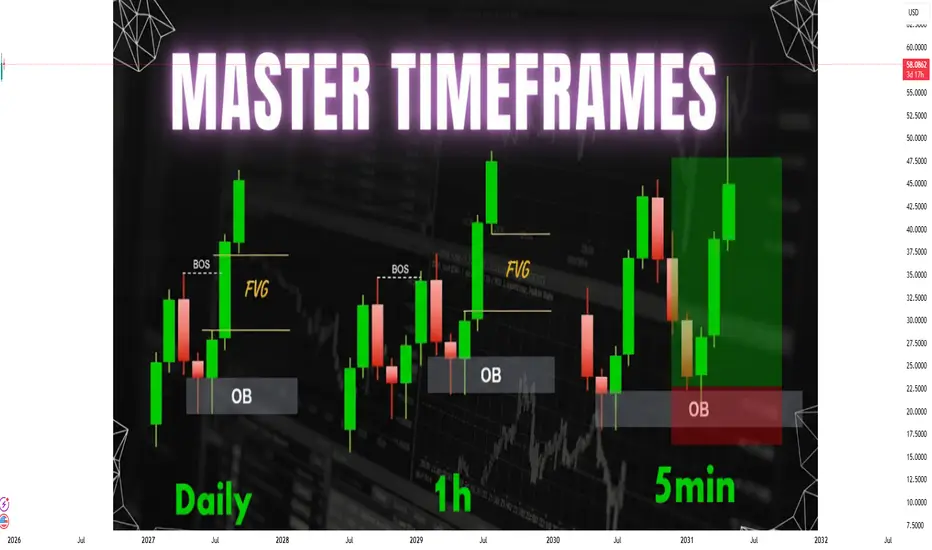
1. Why Multi-Timeframe Analysis Matters
Markets are fractal in nature—meaning price moves in repeating patterns across all timeframes. A trend visible on the 1-hour chart may simply be a pullback on the daily chart. A breakout on the 5-minute chart may be irrelevant when the weekly trend is sideways.
Relying only on one timeframe creates three common issues:
False breakouts: Lower timeframes give misleading breakouts during higher-timeframe consolidations.
Confusion about trend: The trend on a small timeframe often conflicts with the major trend.
Entries without context: Traders enter without understanding key support/resistance or institutional zones.
MTFA solves all these problems by combining macro and micro views to form decisions rooted in context.
2. The Top-Down Approach (The Standard MTFA Process)
Most traders follow a 3-step method:
Step 1: Identify the Main Trend (Higher Timeframe – HTF)
Use Weekly, Daily, or 4H depending on your style.
Here you look for:
Overall trend direction (uptrend / downtrend / range)
Major support and resistance
Market structure (HH, HL, LH, LL)
Long-term supply and demand zones
HTF gives you the “big picture”—the dominant force of the market.
Step 2: Refine the Setup Zone (Middle Timeframe – MTF)
Use Daily-4H, 4H-1H, or 1H-15M depending on the trade.
This timeframe helps confirm:
Trend alignment
Pullbacks
Break of structure
Chart patterns (flags, triangles, channels)
Key levels where entries may occur
MTF filters out low-probability setups and identifies accurate zones.
Step 3: Execute With Precision (Lower Timeframe – LTF)
Use 1H, 15M, 5M, or 1M for exact entries.
This timeframe helps you:
Time entries
Catch liquidity grabs
Place tight stop-losses
Monitor candle patterns (pin bars, engulfing, doji)
Confirm momentum using volume/RSI/stochastic
This is where the actual trade triggers happen.
3. Choosing the Right Timeframes (Based on Trading Style)
Different trading styles require different combinations.
1. Scalpers
HTF: 1H
MTF: 15M
LTF: 1M–5M
Goal: Quick moves, tight SL, small targets.
2. Intraday Traders
HTF: Daily
MTF: 1H
LTF: 5M–15M
Goal: Catch day moves with strong accuracy.
3. Swing Traders
HTF: Weekly
MTF: Daily
LTF: 4H
Goal: Hold trades for days to weeks.
4. Position Traders
HTF: Monthly
MTF: Weekly
LTF: Daily
Goal: Capture major multi-month trends.
The key rule:
The larger timeframe decides trend direction; the smaller timeframe decides entry timing.
4. How MTFA Improves Trading Accuracy
1. Identifying True Trend Direction
A rise on the 15-minute chart may look bullish, but on the daily chart it may be a simple retracement in a strong downtrend. MTFA prevents trading against the dominant direction.
2. Avoiding Market Noise
Lower timeframes contain lots of fake moves (whipsaws). MTFA filters them out by relying on higher-timeframe structure.
3. Improved Entry and Exit
You can wait for precise structure breaks or candle confirmations on smaller timeframes while holding the higher-timeframe bias.
4. Better Risk Management
Since entries become more accurate, stop-loss distance reduces while keeping the same reward potential, thus improving risk-to-reward ratio (RRR).
5. Practical MTFA Example (Bullish Scenario)
Let’s say you are analyzing a stock or index.
Weekly Chart
Showing a clear uptrend (higher highs and higher lows).
Price currently retracing toward a major support zone.
Bias: Long (buy).
Daily Chart
Shows a bullish reversal pattern—like a double bottom or bullish engulfing candle.
Market structure shifts from lower lows to higher lows.
Bias strengthened: Prepare for long entries.
1-Hour Chart
Shows break of a short-term downward trendline.
A pullback retests a demand zone.
Entry triggers form: pin bar, engulfing, volume spike.
Execution: Enter long with confidence.
Here:
HTF gave direction.
MTF confirmed reversal.
LTF gave precision timing.
6. Understanding Conflicts Between Timeframes
Sometimes timeframes disagree:
Daily is bullish, but 1H is bearish.
4H shows consolidation, but 15M shows breakouts.
This is normal.
Rule:
The higher timeframe always overrides the lower timeframe.
If the HTF is bullish and LTF is bearish, the bearish move is likely a retracement—not a reversal.
Only when HTF breaks its structure should you consider changing bias.
7. Tools and Indicators Used in MTFA
MTFA does not depend on indicators, but indicators can support analysis.
Useful Tools
Price Action & Candlestick Patterns
Market Structure (HH, HL, LH, LL)
Support & Resistance Levels
Trendlines & Channels
Supply and Demand Zones
Helpful Indicators
Moving Averages (20/50/200) – for trend confirmation
RSI or Stochastic – for momentum and overbought/oversold
Volume – confirms strength of breakouts
MACD – for trend shifts
Key rule:
Indicators can support, but higher timeframe structure must lead the analysis.
8. Common MTFA Mistakes to Avoid
1. Overusing Too Many Timeframes
Using more than 3–4 creates confusion.
Stick to a simple framework: HTF + MTF + LTF.
2. Taking Trades Against the Higher-Timeframe Trend
This results in low-probability trades.
3. Forcing Breakouts on Small Timeframes
A breakout on 5M may be meaningless if the daily timeframe is in a strong range.
4. Not Waiting for Alignment
All timeframes must agree before entering.
5. Ignoring Key Levels
Higher-timeframe S/R zones are where major institutions trade.
9. Benefits of Mastering MTFA
Increases trade accuracy
Reduces emotional trades
Provides clear market structure
Helps catch major moves
Improves reward-to-risk
Builds professional-level discipline
Works in any market (stocks, forex, crypto, commodities, indices)
10. Summary of Multi-Timeframe Analysis
MTFA combines higher, middle, and lower timeframe views.
Higher timeframe shows trend and major levels.
Lower timeframe shows entry and precision.
MTFA avoids noise, false breakouts, and misleading signals.
It enhances risk management and trade quality.
All successful traders use MTFA, from scalpers to swing traders.
Markets are fractal in nature—meaning price moves in repeating patterns across all timeframes. A trend visible on the 1-hour chart may simply be a pullback on the daily chart. A breakout on the 5-minute chart may be irrelevant when the weekly trend is sideways.
Relying only on one timeframe creates three common issues:
False breakouts: Lower timeframes give misleading breakouts during higher-timeframe consolidations.
Confusion about trend: The trend on a small timeframe often conflicts with the major trend.
Entries without context: Traders enter without understanding key support/resistance or institutional zones.
MTFA solves all these problems by combining macro and micro views to form decisions rooted in context.
2. The Top-Down Approach (The Standard MTFA Process)
Most traders follow a 3-step method:
Step 1: Identify the Main Trend (Higher Timeframe – HTF)
Use Weekly, Daily, or 4H depending on your style.
Here you look for:
Overall trend direction (uptrend / downtrend / range)
Major support and resistance
Market structure (HH, HL, LH, LL)
Long-term supply and demand zones
HTF gives you the “big picture”—the dominant force of the market.
Step 2: Refine the Setup Zone (Middle Timeframe – MTF)
Use Daily-4H, 4H-1H, or 1H-15M depending on the trade.
This timeframe helps confirm:
Trend alignment
Pullbacks
Break of structure
Chart patterns (flags, triangles, channels)
Key levels where entries may occur
MTF filters out low-probability setups and identifies accurate zones.
Step 3: Execute With Precision (Lower Timeframe – LTF)
Use 1H, 15M, 5M, or 1M for exact entries.
This timeframe helps you:
Time entries
Catch liquidity grabs
Place tight stop-losses
Monitor candle patterns (pin bars, engulfing, doji)
Confirm momentum using volume/RSI/stochastic
This is where the actual trade triggers happen.
3. Choosing the Right Timeframes (Based on Trading Style)
Different trading styles require different combinations.
1. Scalpers
HTF: 1H
MTF: 15M
LTF: 1M–5M
Goal: Quick moves, tight SL, small targets.
2. Intraday Traders
HTF: Daily
MTF: 1H
LTF: 5M–15M
Goal: Catch day moves with strong accuracy.
3. Swing Traders
HTF: Weekly
MTF: Daily
LTF: 4H
Goal: Hold trades for days to weeks.
4. Position Traders
HTF: Monthly
MTF: Weekly
LTF: Daily
Goal: Capture major multi-month trends.
The key rule:
The larger timeframe decides trend direction; the smaller timeframe decides entry timing.
4. How MTFA Improves Trading Accuracy
1. Identifying True Trend Direction
A rise on the 15-minute chart may look bullish, but on the daily chart it may be a simple retracement in a strong downtrend. MTFA prevents trading against the dominant direction.
2. Avoiding Market Noise
Lower timeframes contain lots of fake moves (whipsaws). MTFA filters them out by relying on higher-timeframe structure.
3. Improved Entry and Exit
You can wait for precise structure breaks or candle confirmations on smaller timeframes while holding the higher-timeframe bias.
4. Better Risk Management
Since entries become more accurate, stop-loss distance reduces while keeping the same reward potential, thus improving risk-to-reward ratio (RRR).
5. Practical MTFA Example (Bullish Scenario)
Let’s say you are analyzing a stock or index.
Weekly Chart
Showing a clear uptrend (higher highs and higher lows).
Price currently retracing toward a major support zone.
Bias: Long (buy).
Daily Chart
Shows a bullish reversal pattern—like a double bottom or bullish engulfing candle.
Market structure shifts from lower lows to higher lows.
Bias strengthened: Prepare for long entries.
1-Hour Chart
Shows break of a short-term downward trendline.
A pullback retests a demand zone.
Entry triggers form: pin bar, engulfing, volume spike.
Execution: Enter long with confidence.
Here:
HTF gave direction.
MTF confirmed reversal.
LTF gave precision timing.
6. Understanding Conflicts Between Timeframes
Sometimes timeframes disagree:
Daily is bullish, but 1H is bearish.
4H shows consolidation, but 15M shows breakouts.
This is normal.
Rule:
The higher timeframe always overrides the lower timeframe.
If the HTF is bullish and LTF is bearish, the bearish move is likely a retracement—not a reversal.
Only when HTF breaks its structure should you consider changing bias.
7. Tools and Indicators Used in MTFA
MTFA does not depend on indicators, but indicators can support analysis.
Useful Tools
Price Action & Candlestick Patterns
Market Structure (HH, HL, LH, LL)
Support & Resistance Levels
Trendlines & Channels
Supply and Demand Zones
Helpful Indicators
Moving Averages (20/50/200) – for trend confirmation
RSI or Stochastic – for momentum and overbought/oversold
Volume – confirms strength of breakouts
MACD – for trend shifts
Key rule:
Indicators can support, but higher timeframe structure must lead the analysis.
8. Common MTFA Mistakes to Avoid
1. Overusing Too Many Timeframes
Using more than 3–4 creates confusion.
Stick to a simple framework: HTF + MTF + LTF.
2. Taking Trades Against the Higher-Timeframe Trend
This results in low-probability trades.
3. Forcing Breakouts on Small Timeframes
A breakout on 5M may be meaningless if the daily timeframe is in a strong range.
4. Not Waiting for Alignment
All timeframes must agree before entering.
5. Ignoring Key Levels
Higher-timeframe S/R zones are where major institutions trade.
9. Benefits of Mastering MTFA
Increases trade accuracy
Reduces emotional trades
Provides clear market structure
Helps catch major moves
Improves reward-to-risk
Builds professional-level discipline
Works in any market (stocks, forex, crypto, commodities, indices)
10. Summary of Multi-Timeframe Analysis
MTFA combines higher, middle, and lower timeframe views.
Higher timeframe shows trend and major levels.
Lower timeframe shows entry and precision.
MTFA avoids noise, false breakouts, and misleading signals.
It enhances risk management and trade quality.
All successful traders use MTFA, from scalpers to swing traders.

I built a Buy & Sell Signal Indicator with 85% accuracy.
📈 Get access via DM or
WhatsApp: wa.link/d997q0
Contact - +91 76782 40962
| Email: techncialexpress@gmail.com
| Script Coder | Trader | Investor | From India
📈 Get access via DM or
WhatsApp: wa.link/d997q0
Contact - +91 76782 40962
| Email: techncialexpress@gmail.com
| Script Coder | Trader | Investor | From India
Bài đăng liên quan
Thông báo miễn trừ trách nhiệm
Thông tin và các ấn phẩm này không nhằm mục đích, và không cấu thành, lời khuyên hoặc khuyến nghị về tài chính, đầu tư, giao dịch hay các loại khác do TradingView cung cấp hoặc xác nhận. Đọc thêm tại Điều khoản Sử dụng.
I built a Buy & Sell Signal Indicator with 85% accuracy.
📈 Get access via DM or
WhatsApp: wa.link/d997q0
Contact - +91 76782 40962
| Email: techncialexpress@gmail.com
| Script Coder | Trader | Investor | From India
📈 Get access via DM or
WhatsApp: wa.link/d997q0
Contact - +91 76782 40962
| Email: techncialexpress@gmail.com
| Script Coder | Trader | Investor | From India
Bài đăng liên quan
Thông báo miễn trừ trách nhiệm
Thông tin và các ấn phẩm này không nhằm mục đích, và không cấu thành, lời khuyên hoặc khuyến nghị về tài chính, đầu tư, giao dịch hay các loại khác do TradingView cung cấp hoặc xác nhận. Đọc thêm tại Điều khoản Sử dụng.