PINE LIBRARY
Cập nhật KernelFunctions
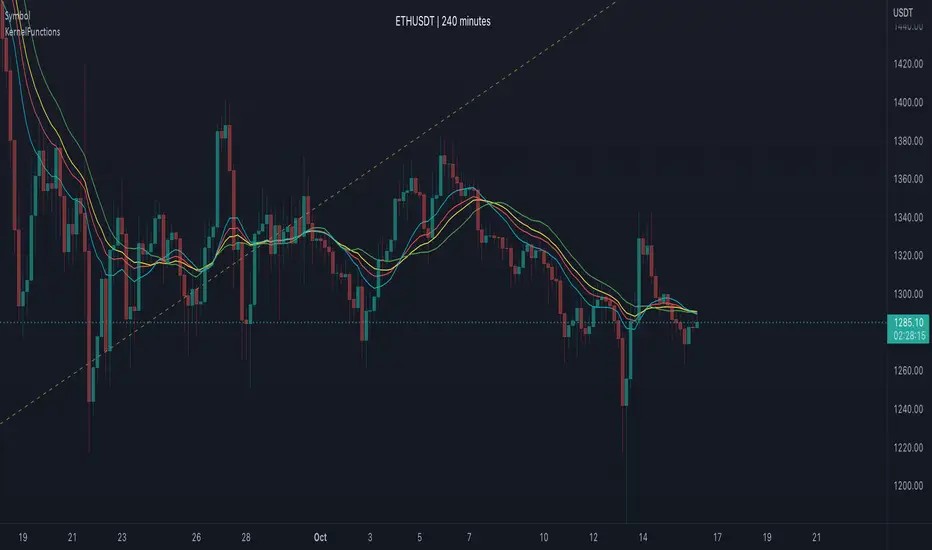
Library "KernelFunctions"
This library provides non-repainting kernel functions for Nadaraya-Watson estimator implementations. This allows for easy substitution/comparison of different kernel functions for one another in indicators. Furthermore, kernels can easily be combined with other kernels to create newer, more customized kernels. Compared to Moving Averages (which are really just simple kernels themselves), these kernel functions are more adaptive and afford the user an unprecedented degree of customization and flexibility.
rationalQuadratic(_src, _lookback, _relativeWeight, _startAtBar)
Rational Quadratic Kernel - An infinite sum of Gaussian Kernels of different length scales.
Parameters:
_src: <float series> The source series.
_lookback: <simple int> The number of bars used for the estimation. This is a sliding value that represents the most recent historical bars.
_relativeWeight: <simple float> Relative weighting of time frames. Smaller values result in a more stretched-out curve, and larger values will result in a more wiggly curve. As this value approaches zero, the longer time frames will exert more influence on the estimation. As this value approaches infinity, the behavior of the Rational Quadratic Kernel will become identical to the Gaussian kernel.
_startAtBar: <simple int> Bar index on which to start regression. The first bars of a chart are often highly volatile, and omitting these initial bars often leads to a better overall fit.
Returns: yhat <float series> The estimated values according to the Rational Quadratic Kernel.
gaussian(_src, _lookback, _startAtBar)
Gaussian Kernel - A weighted average of the source series. The weights are determined by the Radial Basis Function (RBF).
Parameters:
_src: <float series> The source series.
_lookback: <simple int> The number of bars used for the estimation. This is a sliding value that represents the most recent historical bars.
_startAtBar: <simple int> Bar index on which to start regression. The first bars of a chart are often highly volatile, and omitting these initial bars often leads to a better overall fit.
Returns: yhat <float series> The estimated values according to the Gaussian Kernel.
periodic(_src, _lookback, _period, _startAtBar)
Periodic Kernel - The periodic kernel (derived by David Mackay) allows one to model functions that repeat themselves exactly.
Parameters:
_src: <float series> The source series.
_lookback: <simple int> The number of bars used for the estimation. This is a sliding value that represents the most recent historical bars.
_period: <simple int> The distance between repititions of the function.
_startAtBar: <simple int> Bar index on which to start regression. The first bars of a chart are often highly volatile, and omitting these initial bars often leads to a better overall fit.
Returns: yhat <float series> The estimated values according to the Periodic Kernel.
locallyPeriodic(_src, _lookback, _period, _startAtBar)
Locally Periodic Kernel - The locally periodic kernel is a periodic function that slowly varies with time. It is the product of the Periodic Kernel and the Gaussian Kernel.
Parameters:
_src: <float series> The source series.
_lookback: <simple int> The number of bars used for the estimation. This is a sliding value that represents the most recent historical bars.
_period: <simple int> The distance between repititions of the function.
_startAtBar: <simple int> Bar index on which to start regression. The first bars of a chart are often highly volatile, and omitting these initial bars often leads to a better overall fit.
Returns: yhat <float series> The estimated values according to the Locally Periodic Kernel.
This library provides non-repainting kernel functions for Nadaraya-Watson estimator implementations. This allows for easy substitution/comparison of different kernel functions for one another in indicators. Furthermore, kernels can easily be combined with other kernels to create newer, more customized kernels. Compared to Moving Averages (which are really just simple kernels themselves), these kernel functions are more adaptive and afford the user an unprecedented degree of customization and flexibility.
rationalQuadratic(_src, _lookback, _relativeWeight, _startAtBar)
Rational Quadratic Kernel - An infinite sum of Gaussian Kernels of different length scales.
Parameters:
_src: <float series> The source series.
_lookback: <simple int> The number of bars used for the estimation. This is a sliding value that represents the most recent historical bars.
_relativeWeight: <simple float> Relative weighting of time frames. Smaller values result in a more stretched-out curve, and larger values will result in a more wiggly curve. As this value approaches zero, the longer time frames will exert more influence on the estimation. As this value approaches infinity, the behavior of the Rational Quadratic Kernel will become identical to the Gaussian kernel.
_startAtBar: <simple int> Bar index on which to start regression. The first bars of a chart are often highly volatile, and omitting these initial bars often leads to a better overall fit.
Returns: yhat <float series> The estimated values according to the Rational Quadratic Kernel.
gaussian(_src, _lookback, _startAtBar)
Gaussian Kernel - A weighted average of the source series. The weights are determined by the Radial Basis Function (RBF).
Parameters:
_src: <float series> The source series.
_lookback: <simple int> The number of bars used for the estimation. This is a sliding value that represents the most recent historical bars.
_startAtBar: <simple int> Bar index on which to start regression. The first bars of a chart are often highly volatile, and omitting these initial bars often leads to a better overall fit.
Returns: yhat <float series> The estimated values according to the Gaussian Kernel.
periodic(_src, _lookback, _period, _startAtBar)
Periodic Kernel - The periodic kernel (derived by David Mackay) allows one to model functions that repeat themselves exactly.
Parameters:
_src: <float series> The source series.
_lookback: <simple int> The number of bars used for the estimation. This is a sliding value that represents the most recent historical bars.
_period: <simple int> The distance between repititions of the function.
_startAtBar: <simple int> Bar index on which to start regression. The first bars of a chart are often highly volatile, and omitting these initial bars often leads to a better overall fit.
Returns: yhat <float series> The estimated values according to the Periodic Kernel.
locallyPeriodic(_src, _lookback, _period, _startAtBar)
Locally Periodic Kernel - The locally periodic kernel is a periodic function that slowly varies with time. It is the product of the Periodic Kernel and the Gaussian Kernel.
Parameters:
_src: <float series> The source series.
_lookback: <simple int> The number of bars used for the estimation. This is a sliding value that represents the most recent historical bars.
_period: <simple int> The distance between repititions of the function.
_startAtBar: <simple int> Bar index on which to start regression. The first bars of a chart are often highly volatile, and omitting these initial bars often leads to a better overall fit.
Returns: yhat <float series> The estimated values according to the Locally Periodic Kernel.
Phát hành các Ghi chú
v2Updated:
Allow float for relativeWeight of the Rational Quadratic Kernel
rationalQuadratic(_src, _lookback, _relativeWeight, _startAtBar)
Rational Quadratic Kernel - An infinite sum of Gaussian Kernels of different length scales.
Parameters:
_src: <float series> The source series.
_lookback: <simple int> The number of bars used for the estimation. This is a sliding value that represents the most recent historical bars.
_relativeWeight: <simple float> Relative weighting of time frames. Smaller values resut in a more stretched out curve and larger values will result in a more wiggly curve. As this value approaches zero, the longer time frames will exert more influence on the estimation. As this value approaches infinity, the behavior of the Rational Quadratic Kernel will become identical to the Gaussian kernel.
_startAtBar: <simple int> Bar index on which to start regression. The first bars of a chart are often highly volatile, and omission of these initial bars often leads to a better overall fit.
Returns: yhat <float series> The estimated values according to the Rational Quadratic Kernel.
Thư viện Pine
Theo đúng tinh thần TradingView, tác giả đã công bố mã Pine này như một thư viện mã nguồn mở để các lập trình viên Pine khác trong cộng đồng có thể tái sử dụng. Chúc mừng tác giả! Bạn có thể sử dụng thư viện này cho mục đích cá nhân hoặc trong các ấn phẩm mã nguồn mở khác, nhưng việc tái sử dụng mã này trong các ấn phẩm phải tuân theo Nội Quy.

🚀 User Guides: ai-edge.io/
❤️ Premium Indicators: patreon.com/jdehorty
🎥 Tutorials: youtu.be/AdINVvnJfX4
🤖 Discord: discord.com/invite/djXT5sAPfQ
⏩ LinkedIn: linkedin.com/in/justin-dehorty
❤️ Premium Indicators: patreon.com/jdehorty
🎥 Tutorials: youtu.be/AdINVvnJfX4
🤖 Discord: discord.com/invite/djXT5sAPfQ
⏩ LinkedIn: linkedin.com/in/justin-dehorty
Thông báo miễn trừ trách nhiệm
Thông tin và các ấn phẩm này không nhằm mục đích, và không cấu thành, lời khuyên hoặc khuyến nghị về tài chính, đầu tư, giao dịch hay các loại khác do TradingView cung cấp hoặc xác nhận. Đọc thêm tại Điều khoản Sử dụng.
Thư viện Pine
Theo đúng tinh thần TradingView, tác giả đã công bố mã Pine này như một thư viện mã nguồn mở để các lập trình viên Pine khác trong cộng đồng có thể tái sử dụng. Chúc mừng tác giả! Bạn có thể sử dụng thư viện này cho mục đích cá nhân hoặc trong các ấn phẩm mã nguồn mở khác, nhưng việc tái sử dụng mã này trong các ấn phẩm phải tuân theo Nội Quy.
🚀 User Guides: ai-edge.io/
❤️ Premium Indicators: patreon.com/jdehorty
🎥 Tutorials: youtu.be/AdINVvnJfX4
🤖 Discord: discord.com/invite/djXT5sAPfQ
⏩ LinkedIn: linkedin.com/in/justin-dehorty
❤️ Premium Indicators: patreon.com/jdehorty
🎥 Tutorials: youtu.be/AdINVvnJfX4
🤖 Discord: discord.com/invite/djXT5sAPfQ
⏩ LinkedIn: linkedin.com/in/justin-dehorty
Thông báo miễn trừ trách nhiệm
Thông tin và các ấn phẩm này không nhằm mục đích, và không cấu thành, lời khuyên hoặc khuyến nghị về tài chính, đầu tư, giao dịch hay các loại khác do TradingView cung cấp hoặc xác nhận. Đọc thêm tại Điều khoản Sử dụng.