Buy Signal EMA & RSI Strategy [CocoChoco]Strategy to back test my published indicator under the same name: Buy Signal EMA & RSI Strategy Chiến lược Pine Script®của CocoChoco111
Volatility Expansion Indicator - D_QuantVolatility Expansion Indicator - D_Quant |V|C|E| 1. Concept & Overview The Volatility Expansion Indicator (VCE) is a composite quantitative tool designed to identify robust trend states by aggregating signals from three distinct market dimensions: Relative Position (Volatility), Cyclical Momentum, and Price Velocity. Unlike single-source indicators which often generate false positives during choppy markets, the VCE utilizes a "Consensus Engine." It normalizes signals from Bollinger %B, CCI, and ROC into a unified trend score (-1 to +1). This score drives the visual coloring of the price action and background, allowing traders to instantly gauge whether the market is in a state of volatility expansion (trending) or contraction (ranging). 2. Methodology & Calculation The core logic relies on a weighted aggregation of three technical components. Users can toggle these components on or off in the settings to isolate specific market mechanics. A. Component 1: Bollinger %B (Relative Positioning) Logic: Measures where the price is located relative to the Bollinger Bands. Bullish Condition: If %B > 0.5 (Price is operating in the upper hemisphere of the bands). Bearish Condition: If %B < 0.0 (Price has broken below the lower band). Purpose: Filters out weak trends by ensuring price is statistically significant relative to its recent volatility. B. Component 2: CCI (Commodity Channel Index) Logic: Measures current price levels relative to an average price level over a specific period. Thresholds: A standard +100 / -100 threshold is used. Values above 100 add to the bullish score; values below -100 add to the bearish score. Purpose: Identifies cyclical momentum extremes. f_cci(_len) => cci_val = ta.cci(close, _len) val = 0 if cci_val > 100 val := 1 if cci_val < -100 val := -1 val C. Component 3: ROC (Rate of Change) Logic: Calculates the percentage change between the current price and the price n periods ago. Thresholds: Simple zero-line crossover. Positive ROC implies bullish velocity; negative implies bearish. Purpose: Provides a raw directional bias based on pure price speed. D. The Aggregation Engine: The script sums the active signals and divides by the number of active components. Bullish Trend: Composite Score > 0 (Visualized as Deep Navy). Bearish/Neutral: Composite Score ≤ 0 (Visualized as White). E. Multi-Timeframe (MTF) Capability: The indicator includes a request.security module. This allows you to calculate the consensus trend on a higher timeframe (e.g., Daily) while viewing price action on a lower timeframe (e.g., 15-minute), ensuring you are trading in alignment with the macro trend. // NEW: Timeframe Selection tf_input = input.timeframe("", "VCE Timeframe", group=grp_sets, tooltip="Empty = Current Chart. Set to 'D' for fixed Daily trend.") = request.security(syminfo.tickerid, tf_input, , lookahead=barmerge.lookahead_on) 3. Visualizations The indicator overlays the following elements on the chart: Trend SMMA: A central Smoothed Moving Average (SMMA 20) representing the mean. Volatility Bands: Upper and Lower bands calculated at 2 Standard Deviations from the SMMA. Bar Coloring: Navy Blue: Indicates a confirmed Volatility Expansion (Bullish Confluence). White: Indicates Neutrality, Retracement, or Bearish conditions. Dynamic Fills: The space between the bands fills with color to highlight the strength of the current regime. 4. How to Use Trend Following: Look for the bar color to switch to Navy. This indicates that momentum, volatility, and velocity have aligned bullishly. This is often an entry trigger for long positions. Exits: When the bars switch from Navy back to White/Gray, the volatility expansion has ceased or momentum is diverging. This serves as a warning to tighten stops or take profits. MTF Filter: Set the "VCE Timeframe" input to "D" (Daily). Trade on the H1 chart. Only take long positions when the Daily VCE paints the background/bands in the Bullish color. 5. Settings Bollinger %B: Adjust Length and Multiplier (Default: 20, 2.0). CCI: Adjust Length (Default: 23). ROC: Adjust Length (Default: 50). Signal Components: Toggle specific logic blocks on/off to customize the sensitivity of the composite score. VCE Timeframe: Select the resolution for the calculation (Leave empty for current chart). Disclaimer: This tool is for informational purposes only. Past performance of volatility expansion does not guarantee future results. Always manage risk appropriately.Chỉ báo Pine Script®của D_QUANT15
SAl VWAP LITE SA Final VWAP — LITE (Beginner Guide) This strategy is designed to only take trades when 3 layers agree: Market posture (HTF = 1H VWAP direction) Mid confirmation (MID = 15m VWAP direction) Execution entry (your chart timeframe signal: SMA trend + VWAP + wick flip + RSI) It’s built to avoid chop by requiring trend + location + momentum + a reversal wick trigger. 1) What the script does (in plain English) A Long (green) signal happens only when ALL are true: ✅ HTF VWAP is bullish (price above VWAP on 1H) ✅ MID VWAP is bullish (price above VWAP on 15m) ✅ Execution trend is bullish (SMA3 > SMA8 AND close > SMA8) ✅ Price is above VWAP on your current chart ✅ The prior candle had an upper wick (bearish rejection wick) ✅ RSI is strong (RSI > 55 by default) A Short (red) signal happens only when ALL are true: ✅ HTF VWAP is bearish (price below VWAP on 1H) ✅ MID VWAP is bearish (price below VWAP on 15m) ✅ Execution trend is bearish (SMA3 < SMA8 AND close < SMA8) ✅ Price is below VWAP on your current chart ✅ The prior candle had a lower wick (bullish rejection wick) ✅ RSI is weak (RSI < 45 by default) If those aren’t met, candles stay gray = no trade / neutral. 2) How to add it on TradingView (step-by-step) Open TradingView Click Pine Editor (bottom panel) Paste the full script Click Save Click Add to chart Go to Strategy Tester (bottom) to view results If you want alerts: You can still create alerts for strategy orders, but it works best if we convert it to an indicator version with alert conditions. (If you want, tell me and I’ll generate that version.) 3) Best instruments to use it on This type of VWAP+trend+RSI filter works best on instruments with: High liquidity Clean trend behavior Tight spreads / stable fills Best: Index futures: NQ / ES Index ETFs: QQQ / SPY Very liquid mega caps: AAPL / MSFT / NVDA Avoid thin stocks or random low-volume names. 4) Best timeframes to run it on (beginner safe) ✅ Recommended execution timeframes (where entries trigger) 1 minute (fast, best if you’re experienced) 3 minute (balanced) 5 minute (most beginner friendly) ✅ Gate timeframes (already built in) HTF = 60 min MID = 15 min These should usually stay as-is. 5) How to interpret the candle colors Green candle = A valid LONG signal fired on that bar Red candle = A valid SHORT signal fired on that bar Gray candle = No signal (do nothing) This is important: Gray is a feature, not a problem. Gray means the system is protecting you from chop. 6) What “Strict Mode (HTF=MID)” really means When Strict Mode = ON: HTF and MID must agree exactly This reduces signals but improves quality When Strict Mode = OFF: HTF alone can allow direction More trades, more noise Beginner rule: keep Strict Mode ON. 7) How to trade it (simple beginner rules) Long trade rules Wait for a green candle (signal candle) Enter at the close of the candle (or next candle open) Use your stop (your script currently uses TP+SL inside strategy) Short trade rules Wait for a red candle Enter at the close (or next candle open) Respect stop loss Most important discipline rule Do not take trades “because it’s close.” Take only when the candle is green/red. 8) Why the wick rule is powerful This is a key “needle shifter.” Long requires prior bearish wick (upper wick): That shows sellers tried to push up resistance / reject price — and failed. If the market is still above VWAP + trend is up, that wick often marks a “dip-then-go” continuation. Short requires prior bullish wick (lower wick): Buyers tried to defend and push up — but got rejected. Under VWAP + downtrend + weak RSI, that wick often becomes the last pullback before continuation down. So the wick rule helps avoid entering mid-candle or late chase entries. 9) How to avoid the 100-point reversal problem you mentioned Those big reversals usually come from one of these: (A) Taking signals inside chop Fix: keep Strict Mode ON, and keep RSI thresholds. (B) Trading directly into a major support/resistance zone Fix: Avoid entries right at prior day high/low, overnight high/low, or major swing points Don’t short directly into support; don’t long into resistance (C) News spikes Fix: Avoid trading major news windows (CPI, FOMC, Powell, NFP) VWAP systems can get steamrolled temporarily during high-impact releases 10) Beginner settings I recommend (starting defaults) Keep these: Strict Mode = ✅ ON RSI Length = 14 RSI Bull > 55 RSI Bear < 45 SMA = 3 & 8 (as you have now) HTF = 60m, MID = 15m If you want fewer trades but higher quality: RSI Bull > 58 RSI Bear < 42 wickMinTicks = 2 (filters tiny meaningless wicks) 11) What you should NOT do (common beginner mistakes) ❌ Don’t take trades when candles are gray ❌ Don’t reverse immediately because the opposite color appears one candle later ❌ Don’t use this as a prediction tool — it’s a confirmation tool ❌ Don’t force trades in low volume periods (midday chop) 12) Best “times of day” to trade it (for index products) For NQ/ES/QQQ/SPY, the cleanest VWAP trend behavior is usually: 9:35–11:00 ET (best) 1:30–3:30 ET (good) Avoid 11:30–1:15 ET (chop zone) Why You Should Monitor the Strategy Report (Very Important) This script is intentionally published as a strategy, not just an indicator. That is by design. The Strategy Tester Report is a core part of how this tool should be evaluated. When you open the Strategy Tester tab in TradingView, you gain insight into: Win rate consistency across timeframes Drawdown behavior during choppy vs trending conditions How often signals occur (selectivity matters) Performance differences between 1m, 3m, and 5m charts The value of the HTF + MID gating logic during high-risk periods ⚠️ Do not judge this tool based on a handful of trades or one session. Its real value shows up when you observe: Fewer trades during chop Cleaner participation during directional sessions Reduced exposure during regime conflict This is exactly why the higher-timeframe VWAP posture and RSI/wick filters exist. 🧠 How to Use the Strategy Report Effectively (Beginner Tip) To properly evaluate the system: Apply the strategy to one instrument (ex: NQ, ES, QQQ) Test one execution timeframe at a time (1m, 3m, or 5m) Keep HTF = 60m and MID = 15m fixed Review results over multiple days, not single sessions Pay attention to: Max drawdown Trade clustering Losing streak behavior (this matters more than win rate alone) This will give you a much more realistic understanding of what the system is designed to do. 🔒 About This Script (Important Notice) This SA Final VWAP — LITE script is intentionally: Condensed Restricted Directionally gated Missing advanced logic layers It represents the last free public release of this VWAP-based framework. The full version includes additional proprietary components such as: Expanded regime classification Enhanced VWAP slope and acceptance logic Advanced no-trade zones Multi-setup prioritization Internal failure-state suppression Additional probabilistic filters not exposed here These components materially change behavior during difficult market conditions and are not included in this public script. 📩 For Serious Users / Full Version Access If you find this indicator useful, insightful, or different from typical TradingView tools, you are encouraged to reach out directly. This script is meant to: Demonstrate the core logic Allow you to validate performance via the strategy report Help you decide whether the full framework is appropriate for your trading 📬 For access to the complete version and additional attributes of the algorithm, contact the author directly. This separation is intentional to: Protect intellectual property Maintain system integrity Ensure serious users receive proper context and guidance 🧭 Final Note This is not a prediction tool. It is a confirmation and participation framework designed to operate when probability, structure, and momentum align. Gray candles are protection. Green and red candles are permission. Use it with patience, discipline, and proper evaluation — and let the strategy report tell you the real story.Chiến lược Pine Script®của SignalArchitecT_AI10
RSI Momentum & Trend Suite - O59 Elite QuantRSI Momentum & Trend Suite – O59 Elite Quant Professional Market Structure & Momentum Analysis Tool RSI Momentum & Trend Suite – O59 Elite Quant is a comprehensive technical analysis indicator designed to help traders better understand market momentum, trend structure, price reactions, and key support & resistance zones directly on the chart. This indicator combines RSI-based momentum analysis, dynamic bar coloring, price action signals, and automatic trend & support/resistance detection into a single, clean visual framework. 🔹 Momentum & Bar Coloring Logic The indicator includes a custom RSI momentum engine that evaluates short-term price changes and momentum strength. Candles are automatically colored when momentum reaches critical zones: Above 70 → Strong bullish momentum Below 30 → Strong bearish momentum This candle coloring helps traders instantly recognize momentum extremes without switching to a separate RSI pane. 🔺 Buy & Sell Triangle Signals The script generates triangle-based buy and sell signals based on a combination of: RSI oversold / overbought conditions Short-term price action behavior Candle structure and confirmation logic These signals are intended to highlight potential reaction zones, not to predict the market. They work best when used together with trend direction and support/resistance levels. 📈 Automatic Trend Detection The indicator automatically identifies ascending and descending trend structures using pivot-based swing analysis. Trendlines are drawn dynamically based on higher lows and lower highs Broken trendlines are automatically removed to keep the chart clean Both bullish and bearish trends are visually distinguished This allows traders to quickly assess whether the market is trending or losing structure. 🟦 Dynamic Support & Resistance Levels Key support and resistance levels are detected using recent pivot points: Levels extend forward in real time Broken levels are removed automatically Helps identify potential reaction, rejection, and liquidity zones These levels are designed to adapt continuously as market structure evolves. 🧾 Information Table & Visual Themes A customizable information table is displayed on the chart, showing: Indicator name Current symbol Active timeframe Author branding Users can choose between multiple visual themes, allowing better readability and personal preference while maintaining a professional appearance. ⚠️ Important Notes & Risk Disclaimer This indicator is designed as a technical analysis support tool only. It does not provide financial advice Signals and visual elements should not be used alone Always confirm signals with your own strategy, risk management, and market context ⚠️ Special caution is advised during: Low-volume sessions Weekend price action High-impact news events Thin liquidity hours Market conditions during these periods may produce false signals or reduced reliability. 📌 Final Disclaimer This indicator is for educational and analytical purposes only. It is not investment advice. All trading decisions remain the sole responsibility of the use Chỉ báo Pine Script®của olcaybilgu3288
Blockcircle FTR - Follow Through ReversalWHAT THIS INDICATOR DOES Blockcircle FTR identifies failed directional moves followed by quality reversals. The indicator tracks structural pivot levels, monitors price interactions with those levels, and validates reversal sequences against a configurable threshold. A trend filter provides macro context so you can evaluate whether signals align with or oppose the broader direction. KEY FEATURES Reversal quality filtering via delivery threshold requirement Sweep confirmation when reversals follow liquidity grabs at structural levels ATR-adaptive origin zones marking reversal starting points Trend alignment indicator comparing signal bias to moving average direction Volume validation filter for participation confirmation Real-time dashboard with signal statistics and alignment status DETAILED BREAKDOWN Structural Level Tracking The indicator identifies pivot highs and lows based on the Structure Lookback parameter. These pivots serve as reference levels where liquidity typically accumulates. Levels remain active until price interacts with them or they exceed the Level Lifespan setting. When the price reaches a structural level, this interaction is logged. If a reversal then forms in the opposite direction within the Sweep Window, the signal qualifies as sweep-confirmed, indicating that stops were likely triggered before the move reversed. FTR Detection Logic The core detection looks for a specific sequence: a directional attempt that fails to follow through, followed by a counter-move that meets the Delivery Threshold ratio. This ratio measures the quality of the reversal relative to the failed move's structure. Higher threshold values (closer to 1.0) require cleaner, more convincing reversals. Lower values (closer to 0.1) allow weaker setups through. The default of 0.7 provides reasonable filtering without being overly restrictive. Trend Context Filter A moving average (EMA or SMA, configurable period) provides simple trend context. The dashboard displays three related metrics: Trend: Current price position relative to the MA (Bullish/Bearish) FTR Bias: Direction of the most recent confirmed signal (Long/Short) Aligned: Whether these two readings match (Yes/No) This helps identify situations where the FTR bias has become stale or is positioned against the prevailing trend. Signal Classification Standard signals appear as small triangles and represent FTR patterns that passed the delivery threshold and any active filters. Sweep-confirmed signals appear with an "S" label and represent the subset of signals where price swept a structural level shortly before the reversal formed. These carry higher conviction due to the additional liquidity context. Dashboard Metrics The information panel provides: Current trend direction and FTR bias Alignment status between the two Bars elapsed since the last signal Running totals for long and short signals Sweep-confirmed counts in parentheses Volume filter status Configuration Parameters Structure Lookback: Bars used for pivot detection. Higher values capture more significant swings. Delivery Threshold: Minimum ratio for valid reversals. Range 0.1 to 1.0. Level Lifespan: The maximum bars a structural level remains active. Sweep Window: Lookback period for sweep confirmation. Trend MA Period: Moving average length for trend context. Volume Spike Multiple: Required volume ratio when volume filter is active. Zone Depth: Origin zone width as ATR multiple. Practical Application Sweep-confirmed signals with trend alignment represent the highest-conviction setups. These combine a quality reversal pattern, liquidity sweep context, and trend support. Standard signals without sweep confirmation remain valid FTR patterns but warrant additional discretion. Counter-trend signals (Aligned showing NO) can still produce valid moves, but historically carry lower probability. Consider position sizing adjustments accordingly. Origin zones serve as potential support/resistance areas for subsequent price returns. Important Limitations The indicator may remain biased in the wrong direction during extended trends if no qualifying reversal pattern forms. The trend filter helps identify these situations, but does not automatically override the FTR bias. Signal counts are calculated on visible chart history and will vary based on the loaded timeframe and bar count. As with any technical tool, signals should be evaluated within the broader market context rather than traded mechanically. Hope you find it useful! If you have any questions, please don't hesitate to ask them!Chỉ báo Pine Script®của blockcircle2290
BE-QuantFlow: Adaptive Momentum Trading█ Overview: QuantFlow: Adaptive Momentum Trading QuantFlow is a sophisticated algorithmic momentum trading method designed specifically for indices and high-beta stocks. However, its logic is universal; with appropriate parameter tuning, it adapts to various asset classes and timeframes. While the standard momentum indicators (like RSI or MACD) simply measure how fast price is moving (Velocity), QuantFlow analyzes the quality and conviction of the trend . Features like Dynamic Volatility Filtering and Trend Shielding, combined with volatility weighting and a "Dual-Line" approach to distinguish between a sustainable institutional trend and a temporary retail spike, make the indicator unique and more powerful. █ Why QuantFlow ? Quant (The Engine): This replaces subjective guessing with objective math. Instead of just seeing that the price is "up," we measure "how it got there". For example, a stock that rises 1 currency value every day for 10 days (smooth trend) gets a much higher score than a stock that jumps 10 currency value in one minute and does nothing else (erratic noise). This mathematical rigor provides the structure. █ Core Logic & Philosophy To understand how QuantFlow calculates momentum, imagine a "Tug-of-War" between Buyers (Bulls) and Sellers (Bears). Most indicators (like RSI) use a single line. If RSI is at 50, it means "Neutral." But "Neutral" can mean two very different things: Peace: Nothing is happening. No one is buying or selling. War: Buyers are pushing hard, but Sellers are pushing back equally hard. Volatility is massive. A single line hides this reality. QuantFlow splits the market into two separate scores: Bull Score (Green Line): How hard are the buyers pushing? Bear Score (Red Line): How hard are the sellers pushing? The Layman's Advantage: If both lines are low = Sleepy Market (Avoid). If Green is high and Red is low = Clean Uptrend (Buy). If Red is high and Green is low = Clean Downtrend (Sell). If both lines are high = Chaos/War Zone (Wait). █ How it Weight "Sustenance" (The Critical Quality Check) This is the most unique aspect of QuantFlow: Trend direction alone is not enough; Sustenance is weighed equally . Standard indicators treat every 10 currency value movements the same way with no distinction. However, QuantFlow asks, "Did you hold the ground you gained?" Scenario A (High Sustenance) : A stock opens at 100, marches to 110, and closes at 110. Verdict : Buyers pushed up and sustained the price. QuantFlow Weight : 100%. This is a high-quality move. Scenario B (Low Sustenance) : A stock opens at 100, spikes to 110, but gets sold off to close at 102. Verdict : Buyers pushed up (Trend is Up), but failed to sustain it (Long Wick). QuantFlow Weight : 20%. This is treated as "Noise" or a trap. By mathematically weighing the Close Location Value (where the candle closes relative to its high/low), QuantFlow filters out "Gap-and-Fade" traps and exhaustion spikes that fool traditional indicators. Comparisons: QuantFlow vs. The Rest Calculation Logic : Standard RSI/MACD measures simple price change over time. QuantFlow measures Price Change 'times (x)' Conviction (Sustenance Weighting). Visual Output : Standard tools show a single line (0-100), often hiding market conflict. QuantFlow displays Dual Lines (Bull vs Bear Intensity) to reveal the true state of the battle. Trap Handling : Standard indicators are often fooled by sharp spikes. QuantFlow ignores "Gap-and-Fade" moves with poor closing conviction. Adaptability : Standard tools use static levels (e.g., Overbought > 70). QuantFlow uses Dynamic Bands that adjust automatically to recent volatility. █ Dynamic Volatility Filtering Unlike standard indicators that use fixed levels (e.g., "Buy if RSI > 50"), QuantFlow acknowledges that "50" means something different in a quiet market versus a crashing market. This section explains the statistical engine driving the signals. The Problem with Static Levels : In a low-volatility environment, a momentum score of 55 might indicate a massive breakout. In a high-volatility environment, a score of 55 might just be random noise. A fixed threshold cannot handle both scenarios. The Solution: Adaptive Statistics : The script maintains a memory of the Momentum Events. It doesn't just look at price; it looks at where the momentum occurred in the past and draws a "Noise Zone" (Grey Band). This logic acts as a "Smart Gatekeeper" for trade entries: Scenario A: Inside the Noise (The Filter) If a new momentum signal happens inside the Noise Zone, the script assumes it is likely chop or noise. Action : It forces a wait period. The signal is delayed until the trend sustains itself for Confirm Bars; else the signal is cancelled. This filters out ~70% of false signals in sideways markets. Scenario B: Outside the Noise (The Breakout) If a new momentum signal happens outside the Noise Zone (or the momentum score smashes through the Upper Band), it is statistically significant (an outlier event). Action: It triggers an Immediate Entry. No waiting is required because the move is powerful enough to escape the historical noise zone. █ The ⚠️ "Warning" System (Heads-up for Smart Reversals) While you are directional if there is potential reversal signal, it provides the heads-up warning for a better decision-making █ Special Utility: Ghost Mode For intraday traders, the biggest disruption to "Flow" is the mandatory broker square-off at 3:15 PM (considering Indian Market). Often, a trend continues overnight, and the trader misses the gap-up opening the next morning because their algo was flat. Ghost Mode is a unique feature that runs silently in the background: At Square-off: The strategy closes your official position to satisfy the broker. In the Background: It keeps the trade "alive" virtually (Ghost). Next Morning: If the market opens in the trend's favor, the strategy re-enters the trade automatically. This approach ensures you capture the full swing of the trend, even if you are forced to exit at the previous session. █ Advice on this indicator: Parameter Calibration: The default settings are optimized for BankNifty on 5-minute charts. If you trade stocks, crypto, commodities, or any higher timeframes (e.g., 15-min or hourly), you must adjust these. Low Volatility Assets: Reduce Stop Multiplier to 2.0. High Volatility Assets: Increase Momentum Lookback to 50 to filter noise. Confluence (Additional Confirmation): While QuantFlow is a complete system, using it alongside Key Support/Resistance Levels or Volume Profile provides the highest probability setups. Chiến lược Pine Script®của TradeWiseWithEaseCập nhật 22146
Momentum Burst + Absolute Momentum(TI65) + EP9M)This is a momentum burst indicator popularized by StockBee (hey EGeee). Track the stock absolute momentum for continuation breakout. Last but not least, identify EP9M. It can be Episodic pivot 9M volume breakout as a classic EP (CANSLIM type) for a long term trade or a regular EP9M or EP9M delayed reaction for swing trade. KISS - don't over complicate.Chỉ báo Pine Script®của trade2swing23
CryptoFlux Dynamo [JOAT]CryptoFlux Dynamo: Velocity Scalping Strategy WHAT THIS STRATEGY IS CryptoFlux Dynamo is an open-source Pine Script v6 strategy designed for momentum-based scalping on cryptocurrency perpetual futures. It combines multiple technical analysis methods into a unified system that adapts its behavior based on current market volatility conditions. This script is published open-source so you can read, understand, and modify the complete logic. The description below explains everything the strategy does so that traders who cannot read Pine Script can fully understand how it works before using it. HOW THIS STRATEGY IS ORIGINAL AND WHY THE INDICATORS ARE COMBINED This strategy uses well-known indicators (MACD, EMA, RSI, MFI, Bollinger Bands, Keltner Channels, ATR). The originality is not in the individual indicators themselves, but in the specific way they are integrated into a regime-adaptive system. Here is the detailed justification for why these components are combined and how they work together: The Problem Being Solved: Standard indicator-based strategies use fixed thresholds. For example, a typical MACD strategy might enter when the histogram crosses above zero. However, in cryptocurrency markets, volatility changes dramatically throughout the day and week. A MACD crossover during a low-volatility consolidation period has very different implications than the same crossover during a high-volatility trending period. Using the same entry thresholds and stop distances in both conditions leads to either: Too many false signals during consolidation (if thresholds are loose) Missing valid opportunities during expansion (if thresholds are tight) Stops that are too tight during volatility spikes (causing premature exits) Stops that are too wide during compression (giving back profits) The Solution Approach: This strategy first classifies the current volatility regime using normalized ATR (ATR as a percentage of price), then dynamically adjusts ALL other parameters based on that classification. This creates a context-aware system rather than a static threshold comparison. How Each Component Contributes to the System: ATR-Based Regime Classification (The Foundation) The strategy calculates ATR over 21 periods, smooths it with a 13-period EMA to reduce noise from wicks, then divides by price to get a normalized percentage. This ATR% is classified into three regimes: - Compression (ATR% < 0.8%): Market is consolidating, breakouts are more likely but false signals are common - Expansion (ATR% 0.8% - 1.6%): Normal trending conditions - Velocity (ATR% > 1.6%): High volatility, larger moves but also larger adverse excursions This regime classification then controls stop distances, profit targets, trailing stop offsets, and signal strength requirements. The regime acts as a "meta-parameter" that tunes the entire system. EMA Ribbon (8/21/34) - Trend Structure Detection The three EMAs establish trend direction and structure. When EMA 8 > EMA 21 > EMA 34, the trend structure is bullish. The slope of the middle EMA (21) is calculated over 8 bars and converted to degrees using arctangent. This slope measurement quantifies trend strength, not just direction. Why these specific periods? The 8/21/34 sequence follows Fibonacci-like spacing and provides good separation on 5-minute cryptocurrency charts. The fast EMA (8) responds to immediate price action, the mid EMA (21) represents the short-term trend, and the slow EMA (34) acts as a trend filter. The EMA ribbon works with the regime classification: during compression regimes, the strategy requires stronger ribbon alignment before entry because false breakouts are more common. MACD (8/21/5) - Momentum Measurement The MACD uses faster parameters (8/21/5) than the standard (12/26/9) because cryptocurrency markets move faster than traditional markets. The histogram is smoothed with a 5-period EMA to reduce noise. The key innovation is the adaptive histogram baseline. Instead of using a fixed threshold, the strategy calculates a rolling baseline from the smoothed absolute histogram value, then multiplies by a sensitivity factor (1.15). This means the threshold for "significant momentum" automatically adjusts based on recent momentum levels. The MACD works with the regime classification: during velocity regimes, the histogram baseline is effectively higher because recent momentum has been stronger, preventing entries on relatively weak momentum. RSI (21 period) and MFI (21 period) - Independent Momentum Confirmation RSI measures momentum using price changes only. MFI (Money Flow Index) measures momentum using price AND volume. By requiring both to confirm, the strategy filters out price moves that lack volume support. The 21-period length is longer than typical (14) to reduce noise on 5-minute charts. The trigger threshold (55 for longs, 45 for shorts) is slightly offset from 50 to require momentum in the trade direction, not just neutral readings. These indicators work together: a signal requires RSI > 55 AND MFI > 55 for longs. This dual confirmation reduces false signals from price manipulation or low-volume moves. Bollinger Bands (1.5 mult) and Keltner Channels (1.8 mult) - Squeeze Detection When Bollinger Bands contract inside Keltner Channels, volatility is compressing and a breakout is likely. This is the "squeeze" condition. When the bands expand back outside the channels, the squeeze "releases." The strategy uses a 1.5 multiplier for Bollinger Bands (tighter than standard 2.0) and 1.8 for Keltner Channels. These values were chosen to identify meaningful squeezes on 5-minute cryptocurrency charts without triggering too frequently. The squeeze detection works with the regime classification: squeeze releases during compression regimes receive additional signal strength points because breakouts from consolidation are more significant. Volume Impulse Detection - Institutional Participation Filter The strategy calculates a volume baseline (34-period SMA) and standard deviation. A "volume impulse" is detected when current volume exceeds the baseline by 1.15x OR when the volume z-score exceeds 0.5. This filter ensures entries occur when there is meaningful market participation, not during low-volume periods where price moves are less reliable. Volume impulse is required for all entries and adds points to the composite signal strength score. Cycle Oscillator - Trend Alignment Filter The strategy calculates a 55-period EMA as a cycle basis, then measures price deviation from this basis as a percentage. When price is more than 0.15% above the cycle basis, the cycle is bullish. When more than 0.15% below, the cycle is bearish. This filter prevents counter-trend entries. Long signals require bullish cycle alignment; short signals require bearish cycle alignment. BTC Dominance Filter (Optional) - Market Regime Filter The strategy can optionally use BTC.D (Bitcoin Dominance) as a market regime filter. When BTC dominance is rising (slope > 0.12), the market is in "risk-off" mode and long entries on altcoins are filtered. When dominance is falling (slope < -0.12), short entries are filtered. This filter is optional because the BTC.D data feed may lag during low-liquidity periods. How The Components Work Together (The Mashup Justification): The strategy uses a composite scoring system where each signal pathway contributes points: Trend Break pathway (30 points): Requires EMA ribbon alignment + positive slope + price breaks above recent structure high Momentum Surge pathway (30 points): Requires MACD histogram > adaptive baseline + MACD line > signal + RSI > 55 + MFI > 55 + volume impulse Squeeze Release pathway (25 points): Requires BB inside KC (squeeze) then release + momentum bias + histogram confirmation Micro Pullback pathway (15 points): Requires shallow retracement to fast EMA within established trend + histogram confirmation + volume impulse Additional modifiers: +5 points if volume impulse is present, -5 if absent +5 points in velocity regime, -2 in compression regime +5 points if cycle is aligned, -5 if counter-trend A trade only executes when the composite score reaches the minimum threshold (default 55) AND all filters agree (session, cycle bias, BTC dominance if enabled). This scoring system is the core innovation: instead of requiring ALL conditions to be true (which would generate very few signals) or ANY condition to be true (which would generate too many false signals), the strategy requires ENOUGH conditions to be true, with different conditions contributing different weights based on their reliability. HOW THE STRATEGY CALCULATES ENTRIES AND EXITS Entry Logic: 1. Calculate current volatility regime from ATR% 2. Calculate all indicator values (MACD, EMA, RSI, MFI, squeeze, volume) 3. Evaluate each signal pathway and sum points 4. Check all filters (session, cycle, dominance, kill switch) 5. If composite score >= 55 AND all filters pass, generate entry signal 6. Calculate position size based on risk per trade and regime-adjusted stop distance 7. Execute entry with regime name as comment Position Sizing Formula: RiskCapital = Equity * (0.65 / 100) StopDistance = ATR * StopMultiplier(regime) RawQuantity = RiskCapital / StopDistance MaxQuantity = Equity * (12 / 100) / Price Quantity = min(RawQuantity, MaxQuantity) Quantity = round(Quantity / 0.001) * 0.001 This ensures each trade risks approximately 0.65% of equity regardless of volatility, while capping total exposure at 12% of equity. Stop Loss Calculation: Stop distance is ATR multiplied by a regime-specific multiplier: Compression regime: 1.05x ATR (tighter stops because moves are smaller) Expansion regime: 1.55x ATR (standard stops) Velocity regime: 2.1x ATR (wider stops to avoid premature exits during volatility) Take Profit Calculation: Target distance is ATR multiplied by regime-specific multiplier and base risk/reward: Compression regime: 1.6x ATR * 1.8 base R:R * 0.9 regime bonus = approximately 2.6x ATR Expansion regime: 2.05x ATR * 1.8 base R:R * 1.0 regime bonus = approximately 3.7x ATR Velocity regime: 2.8x ATR * 1.8 base R:R * 1.15 regime bonus = approximately 5.8x ATR Trailing Stop Logic: When adaptive trailing is enabled, the strategy calculates a trailing offset based on ATR and regime: Compression regime: 1.1x base offset (looser trailing to avoid noise) Expansion regime: 1.0x base offset (standard) Velocity regime: 0.8x base offset (tighter trailing to lock in profits during fast moves) The trailing stop only activates when it would be tighter than the initial stop. Momentum Fail-Safe Exits: The strategy closes positions early if momentum reverses: Long positions close if MACD histogram turns negative OR EMA ribbon structure breaks (fast EMA crosses below mid EMA) Short positions close if MACD histogram turns positive OR EMA ribbon structure breaks This prevents holding through momentum reversals even if stop loss hasn't been hit. Kill Switch: If maximum drawdown exceeds 6.5%, the strategy disables new entries until manually reset. This prevents continued trading during adverse conditions. HOW TO USE THIS STRATEGY Step 1: Apply to Chart Use a 5-minute chart of a high-liquidity cryptocurrency perpetual (BTC/USDT, ETH/USDT recommended) Ensure at least 200 bars of history are loaded for indicator stabilization Use standard candlestick charts only (not Heikin Ashi, Renko, or other non-standard types) Step 2: Understand the Visual Elements EMA Ribbon: Three lines (8/21/34 periods) showing trend structure. Bullish when stacked upward, bearish when stacked downward. Background Color: Shows current volatility regime - Indigo/dark blue = Compression (low volatility) - Purple = Expansion (normal volatility) - Magenta/pink = Velocity (high volatility) Bar Colors: Reflect signal strength divergence. Brighter colors indicate stronger directional bias. Triangle Markers: Entry signals. Up triangles below bars = long entry. Down triangles above bars = short entry. Dashboard (top-right): Real-time display of regime, ATR%, signal strengths, position status, stops, targets, and risk metrics. Step 3: Interpret the Dashboard Regime: Current volatility classification (Compression/Expansion/Velocity) ATR%: Normalized volatility as percentage of price Long/Short Strength: Current composite signal scores (0-100) Cycle Osc: Price deviation from 55-period EMA as percentage Dominance: BTC.D slope and filter status Position: Current position direction or "Flat" Stop/Target: Current stop loss and take profit levels Kill Switch: Status of drawdown protection Volume Z: Current volume z-score Impulse: Whether volume impulse condition is met Step 4: Adjust Parameters for Your Needs For more conservative trading: Increase "Minimum Composite Signal Strength" to 65 or higher For more aggressive trading: Decrease to 50 (but expect more false signals) For higher timeframes (15m+): Increase "Structure Break Window" to 12-15, increase "RSI Momentum Trigger" to 58 For lower liquidity pairs: Increase "Volume Impulse Multiplier" to 1.3, increase slippage in strategy properties To disable short selling: Uncheck "Enable Short Structure" To disable BTC dominance filter: Uncheck "BTC Dominance Confirmation" STRATEGY PROPERTIES (BACKTEST SETTINGS) These are the exact settings used in the strategy's Properties dialog box. You must use these same settings when evaluating the backtest results shown in the publication: Initial Capital: $100,000 Justification: This amount is higher than typical retail accounts. I chose this value to demonstrate percentage-based returns that scale proportionally. The strategy uses percentage-based position sizing (0.65% risk per trade), so a $10,000 account would see the same percentage returns with 10x smaller position sizes. The absolute dollar amounts in the backtest should be interpreted as percentages of capital. Commission: 0.04% (commission_value = 0.04) Justification: This reflects typical perpetual futures exchange fees. Major exchanges charge between 0.02% (maker) and 0.075% (taker). The 0.04% value is a reasonable middle estimate. If your exchange charges different fees, adjust this value accordingly. Higher fees will reduce net profitability. Slippage: 1 tick Justification: This is conservative for liquid pairs like BTC/USDT on major exchanges during normal conditions. For less liquid altcoins or during high volatility, actual slippage may be higher. If you trade less liquid pairs, increase this value to 2-3 ticks for more realistic results. Pyramiding: 1 Justification: No position stacking. The strategy holds only one position at a time. This simplifies risk management and prevents overexposure. calc_on_every_tick: true Justification: The strategy evaluates on every price update, not just bar close. This is necessary for scalping timeframes where waiting for bar close would miss opportunities. Note that this setting means backtest results may differ slightly from bar-close-only evaluation. calc_on_order_fills: true Justification: The strategy recalculates immediately after order fills for faster response to position changes. RISK PER TRADE JUSTIFICATION The default risk per trade is 0.65% of equity. This is well within the TradingView guideline that "risking more than 5-10% on a trade is not typically considered viable." With the 12% maximum exposure cap, even if the strategy takes multiple consecutive losses, the total risk remains manageable. The kill switch at 6.5% drawdown provides additional protection by halting new entries during adverse conditions. The position sizing formula ensures that stop distance (which varies by regime) is accounted for, so actual risk per trade remains approximately 0.65% regardless of volatility conditions. SAMPLE SIZE CONSIDERATIONS For statistically meaningful backtest results, you should select a dataset that generates at least 100 trades. On 5-minute BTC/USDT charts, this typically requires: 2-3 months of data during normal market conditions 1-2 months during high-volatility periods 3-4 months during low-volatility consolidation periods The strategy's selectivity (requiring 55+ composite score plus all filters) means it generates fewer signals than less filtered approaches. If your backtest shows fewer than 100 trades, extend the date range or reduce the minimum signal strength threshold. Fewer than 100 trades produces statistically unreliable results. Win rate, profit factor, and other metrics can vary significantly with small sample sizes. STRATEGY DESIGN COMPROMISES AND LIMITATIONS Every strategy involves trade-offs. Here are the compromises made in this design and the limitations you should understand: Selectivity vs. Opportunity Trade-off The 55-point minimum threshold filters many potential trades. This reduces false signals but also misses valid setups that don't meet all criteria. Lowering the threshold increases trade frequency but decreases win rate. There is no "correct" threshold; it depends on your preference for fewer higher-quality signals vs. more signals with lower individual quality. Regime Classification Lag The ATR-based regime detection uses historical data (21 periods + 13-period smoothing). It cannot predict sudden volatility spikes. During flash crashes or black swan events, the strategy may be classified in the wrong regime for several bars before the classification updates. This is an inherent limitation of any lagging indicator. Indicator Parameter Sensitivity The default parameters (MACD 8/21/5, EMA 8/21/34, RSI 21, etc.) are tuned for BTC/ETH perpetuals on 5-minute charts during 2024 market conditions. Different assets, timeframes, or market regimes may require different parameters. There is no guarantee that parameters optimized on historical data will perform similarly in the future. BTC Dominance Filter Limitations The CRYPTOCAP:BTC.D data feed may lag during low-liquidity periods or weekends. The dominance slope calculation uses a 5-bar SMA, adding additional delay. If you notice the filter behaving unexpectedly, consider disabling it. Backtest vs. Live Execution Differences TradingView backtesting does not replicate actual broker execution. Key differences: Backtests assume perfect fills at calculated prices; real execution involves order book depth, latency, and partial fills The calc_on_every_tick setting improves backtest realism but still cannot capture sub-bar price action or order book dynamics Commission and slippage settings are estimates; actual costs vary by exchange, time of day, and market conditions Funding rates on perpetual futures are not modeled in backtests and can significantly impact profitability over time Exchange-specific limitations (position limits, liquidation mechanics, order types) are not modeled Market Condition Dependencies This strategy is designed for trending and breakout conditions. During extended sideways consolidation with no clear direction, the strategy may generate few signals or experience whipsaws. No strategy performs well in all market conditions. Cryptocurrency-Specific Risks Cryptocurrency markets operate 24/7 without session boundaries. This means: No natural "overnight" risk reduction Volatility can spike at any time Liquidity varies significantly by time of day Exchange outages or issues can occur at any time WHAT THIS STRATEGY DOES NOT DO To be straightforward about limitations: This strategy does not guarantee profits. Past backtest performance does not indicate future results. This strategy does not predict the future. It reacts to current conditions based on historical patterns. This strategy does not account for funding rates, which can significantly impact perpetual futures profitability. This strategy does not model exchange-specific execution issues (partial fills, requotes, outages). This strategy does not adapt to fundamental news events or black swan scenarios. This strategy is not optimized for all market conditions. It may underperform during extended consolidation. IMPORTANT RISK WARNINGS Past performance does not guarantee future results. The backtest results shown reflect specific historical market conditions and parameter settings. Markets change constantly, and strategies that performed well historically may underperform or lose money in the future. A single backtest run does not constitute proof of future profitability. Trading involves substantial risk of loss. Cryptocurrency derivatives are highly volatile instruments. You can lose your entire investment. Only trade with capital you can afford to lose completely. This is not financial advice. This strategy is provided for educational and informational purposes only. It does not constitute investment advice, trading recommendations, or any form of financial guidance. The author is not a licensed financial advisor. You are responsible for your own decisions. Before using this strategy with real capital: Thoroughly understand the code and logic by reading the open-source implementation Forward test with paper trading or very small positions for an extended period Verify that commission, slippage, and execution assumptions match your actual trading environment Understand that live results will differ from backtest results Consider consulting with a qualified financial advisor No guarantees or warranties. This strategy is provided "as is" without any guarantees of profitability, accuracy, or suitability for any purpose. The author is not responsible for any losses incurred from using this strategy. OPEN-SOURCE CODE STRUCTURE The strategy code is organized into these sections for readability: Configuration Architecture: Input parameters organized into logical groups (Core Controls, Optimization Constants, Regime Intelligence, Signal Pathways, Risk Architecture, Visualization) Helper Functions: calcQty() for position sizing, clamp01() and normalize() for value normalization, calcMFI() for Money Flow Index calculation Core Indicator Engine: EMA ribbon, ATR and regime classification, MACD with adaptive baseline, RSI, MFI, volume analytics, cycle oscillator, BTC dominance filter, squeeze detection Signal Pathway Logic: Trend break, momentum surge, squeeze release, micro pullback pathways with composite scoring Entry/Exit Orchestration: Signal filtering, position sizing, entry execution, stop/target calculation, trailing stop logic, momentum fail-safe exits Visualization Layer: EMA plots, regime background, bar coloring, signal labels, dashboard table You can read and modify any part of the code. Understanding the logic before deployment is strongly recommended. - Made with passion by officialjackofalltrades Chiến lược Pine Script®của officialjackofalltrades33
ATR Distance from 50 SMA By DanBobDanA simple indicator that measures the distance between current price and the 50 SMA The average momentum swing trade might run 7 times the ATR before pulling back Therefore, its recommended to not buy a stock that is beyond 4 times its ATR to the 50 SMA This script will quickly and easily calculate the 50 SMA to ATR distance for youChỉ báo Pine Script®của meanyface2291110
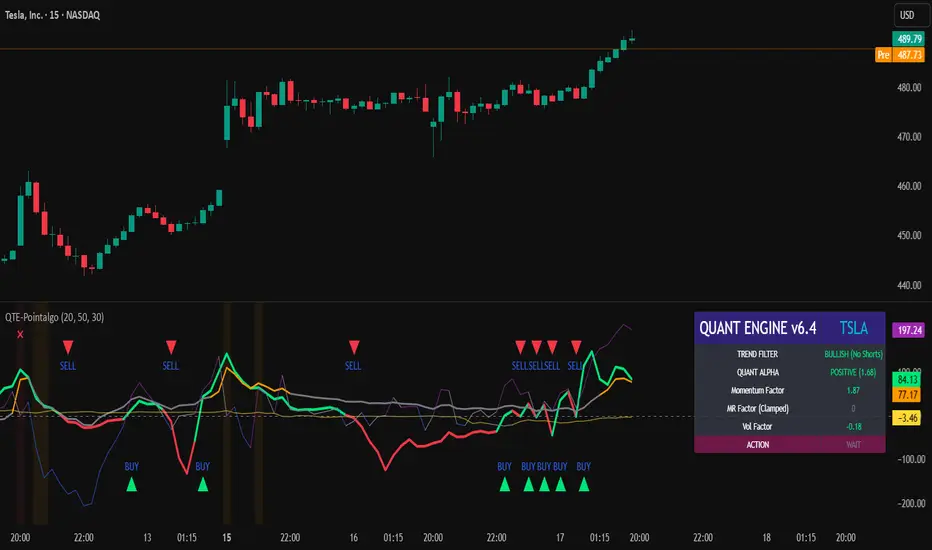
QUANT TRADING ENGINE [PointAlgo]Quant Trading Engine is a quantitative market-analysis indicator that combines multiple statistical factors to study trend behavior, mean reversion, volatility, execution efficiency, and market stability. The indicator converts raw price behavior into standardized signals to help evaluate directional bias and risk conditions in a systematic way. This script focuses on factor alignment and regime awareness, not prediction certainty. Design Philosophy Markets move through different regimes such as trending, ranging, volatile expansion, and instability. This indicator attempts to model these regimes by blending: Momentum strength Mean-reversion pressure Volatility risk Trend filtering Execution context (VWAP) Correlation structure Each component is normalized and combined into a single Quant Alpha framework. Factor Construction 1. Momentum Factor Measures directional strength using percentage price change over a rolling window. Standardized using mean and standard deviation. Represents trend continuation pressure. 2. Mean Reversion Factor Measures deviation from a longer moving average. Standardized to identify stretched conditions. Designed to capture counter-trend behavior. Directional Clamping Mean-reversion signals are dynamically restricted: No counter-trend buying during downtrends. No counter-trend selling during uptrends. Allows both sides only in neutral regimes. This prevents conflicting signals in strong trends. 3. Volatility Factor Uses realized volatility derived from price changes. Penalizes environments where volatility deviates significantly from its norm. Acts as a risk adjustment rather than a directional driver. 4. Composite Quant Alpha The final Quant Alpha is a weighted blend of: Momentum Mean reversion (trend-clamped) Volatility risk The composite is standardized into a Z-score, allowing consistent interpretation across instruments and timeframes. Signal Logic Buy signal occurs when Quant Alpha crosses above zero. Sell signal occurs when Quant Alpha crosses below zero. Zero-cross logic is used to represent shifts from negative to positive statistical bias and vice versa. Signals reflect statistical regime change, not trade instructions. Volatility Smile Context Measures price deviation from its statistical distribution. Identifies skewed conditions where upside or downside volatility becomes dominant. Highlights extreme deviations that may imply elevated derivative risk. Exotic Risk Conditions Detects sudden price expansion combined with volatility spikes. Highlights environments where execution and risk become unstable. Visual background cues are used for awareness only. Execution Context (VWAP) Measures price distance from VWAP. Used to assess execution efficiency rather than direction. Helps identify stretched conditions relative to average traded price. Correlation Structure Evaluates short-term return correlations. Detects when price behavior becomes less predictable. Flags structural instability rather than trend direction. Visualization The indicator plots: Quant Alpha (scaled) with directional coloring Volatility smile deviation Price vs VWAP distance Correlation structure Signal markers indicate Quant Alpha zero-cross events and risk conditions. Dashboard A compact dashboard summarizes: Trend filter state Quant Alpha polarity and value Individual factor readings Current action state (Buy / Sell / Wait / Risk) The dashboard provides a real-time snapshot of internal model conditions. Usage Notes Designed for analytical interpretation and research. Best used alongside price action and risk management tools. Factor behavior depends on instrument liquidity and volatility. Not optimized for illiquid or irregular markets. Disclaimer This script is provided for educational and analytical purposes only. It does not provide financial, investment, or trading advice. All outputs should be independently validated before making any trading decisions.Chỉ báo Pine Script®của pointalgo65
Filtered TEMA CrossoverFiltered Dual TEMA Crossover This indicator is a trend-following tool based on the classic Dual Triple Exponential Moving Average (TEMA) Crossover strategy, enhanced with two robust filters: the Chop Index and the Average Directional Index (ADX). The TEMA is known for its low lag and high responsiveness, making the crossover an effective signal for trend reversals. However, trading TEMA crossovers during sideways, choppy markets often leads to false signals. This is where the filters come in. Key Features ▪️Dual TEMA Crossover: Plots two customizable TEMA lines (Fast and Slow) for clear visualization of the primary trend direction. ▪️Intelligent Signal Filtering: Buy and Sell signals are generated only when the market confirms it is in a trending state, thanks to two integrated filters: ➖Chop Index Filter: Blocks signals when the market is detected as sideways or consolidating (Chop Index reading above a user-defined threshold). ➖ADX Filter: Ensures signals are only taken when the trend strength is sufficient (ADX reading above a user-defined minimum threshold). ▪️Customizable Signals: Full control over the signal shapes (Arrows, Triangles, etc.), colors, text, and size. How to Use It Use the Filtered Dual TEMA Crossover to enter positions on trend continuation or reversal while dramatically reducing exposure to low-quality, whipsawing signals common in non-trending environments. Before the filters: After the filters: Minimize Noise. Maximize Clarity. Trade the Trend.Chỉ báo Pine Script®của ZAUTECCập nhật 82
VCAI Stochastic RSI+VCAI Stoch RSI+ is a cleaned-up Stochastic RSI built with V-Core colours for faster, clearer momentum reads and more reliable OB/OS signals. What it shows: Purple %K line → bearish momentum strengthening Yellow %D line → bullish momentum building and smoothing Soft purple/yellow background bands → OB/OS exhaustion zones, not just raw 80/20 triggers Midline at 50 → balance point where momentum shifts between bull- and bear-side control Optional HTF mode → run Stoch RSI from any timeframe while viewing it on your current chart How to read it: Both lines rising out of OS → early bullish shift; pullbacks that hold direction favour continuation Both lines falling from OB → early bearish shift; bounces into the purple OB zone can become fade setups Lines stacked and moving together → strong, cleaner momentum Lines crossing repeatedly → low-conviction, choppy conditions OB/OS shading highlights exhaustion so you focus on moves with context, not every 80/20 tick Why it’s different: Classic Stoch RSI is hyper-sensitive and mostly noise. VCAI Stoch RSI+ applies V-Core’s colour-driven regime logic, controlled OB/OS shading, and optional HTF smoothing so you see momentum structure instead of clutter — making it easier to judge when momentum is genuinely shifting and when it’s just another wiggle.Chỉ báo Pine Script®của Vectorcoresai21
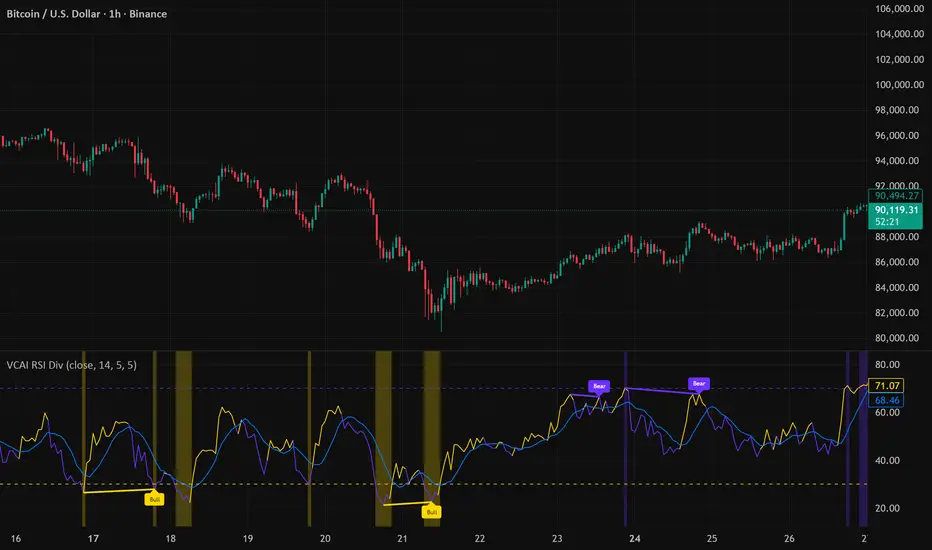
VCAI RSI Divergence +VCAI RSI Divergence+ is an RSI that shows trend, momentum, and divergence using V-CoresAI colour logic instead of a single white line. What it shows: Yellow RSI line → bullish momentum (RSI above its MA; buy-side pressure in control) Purple RSI line → bearish momentum (RSI below its MA; sell-side pressure in control) Thin blue line → fast RSI moving average that drives the colour flips Dashed 70/30 lines → classic OB/OS zones Background bands → soft purple in OB, soft yellow in OS to mark exhaustion areas How to read it: Yellow & rising → momentum shifting bullish; pullbacks into yellow OS band can be accumulation zones Purple & falling → momentum shifting bearish; pushes into purple OB band can be distribution/sell zones Hard colour flips (yellow ↔ purple) mark trend regime changes, not minor RSI noise Divergence mode (on/off) The divergence engine scans RSI and price pivot structure: Bullish divergence (yellow) → price lower low + RSI higher low Bearish divergence (purple) → price higher high + RSI lower high Lines and tags appear only where a meaningful disagreement between price and RSI exists, giving early context for potential reversals or fade setups. Together, the momentum colours + optional divergence mapping give a far clearer market read than a standard RSI, with zero clutter and no guesswork.Chỉ báo Pine Script®của VectorcoresaiCập nhật 54
FluxPulse Momentum [JOAT]FluxPulse Momentum - Adaptive Multi-Component Oscillator FluxPulse Momentum is a composite oscillator that blends three distinct momentum components into a single, smoothed signal line. Rather than relying on a single indicator, it synthesizes adaptive RSI, normalized rate of change, and a Kaufman-style efficiency ratio to provide a multi-dimensional view of momentum. What This Indicator Does Combines RSI, Rate of Change (ROC), and Efficiency Ratio into one weighted composite Applies EMA smoothing to reduce noise while preserving responsiveness Displays overbought/oversold zones with optional background highlighting Generates buy/sell signals when the oscillator crosses its signal line in favorable zones Provides a real-time dashboard showing current state, momentum direction, and efficiency Core Components Adaptive RSI (50% weight) — Standard RSI calculation normalized around the 50 level Normalized ROC (30% weight) — Rate of change scaled relative to its recent maximum range Efficiency Ratio (20% weight) — Measures directional movement efficiency, inspired by Kaufman's adaptive concepts The final composite is smoothed twice using EMA to create both a fast line and a signal line. Signal Logic // Buy signal: crossover in lower half buySignal = ta.crossover(qmo, qmoSmooth) and qmo < 50 // Sell signal: crossunder in upper half sellSignal = ta.crossunder(qmo, qmoSmooth) and qmo > 50 Signals are generated only when the oscillator is positioned favorably—buy signals occur below the 50 midline, sell signals occur above it. Dashboard Information The on-chart table displays: Current oscillator value with gradient coloring Momentum state (Overbought, Oversold, Bullish, Bearish, Neutral) Momentum direction and acceleration Efficiency ratio percentage Active signal status Inputs Overview RSI Length — Period for RSI calculation (default: 14) ROC Length — Period for rate of change (default: 10) Smoothing Length — EMA smoothing period (default: 3) Overbought/Oversold Levels — Threshold levels for zone detection Await Bar Confirmation — Wait for bar close before triggering alerts How to Use It Watch for crossovers between the main line and signal line Use overbought/oversold zones to identify potential reversal areas Monitor the histogram for momentum acceleration or deceleration Combine with price action analysis for confirmation Alerts Buy Signal — Bullish crossover in the lower zone Sell Signal — Bearish crossunder in the upper zone Overbought/Oversold Crosses — Level threshold crossings This indicator is provided for educational purposes. It does not constitute financial advice. Always conduct your own analysis before making trading decisions. — Made with passion by officialjackofalltradesChỉ báo Pine Script®của officialjackofalltrades27
Trend Vector Pro v2.0Trend Vector Pro v2.0 👨💻 Developed by: Mohammed Bedaiwi 💡 Strategy Overview & Coherence Trend Vector Pro (TVPro) is a momentum-based trend & reversal strategy that uses a custom smoothed oscillator, an optional ADX filter, and classic Pivot Points to create a single, coherent trading framework. Instead of stacking random indicators, TVPro is built around these integrated components: A custom momentum engine (signal generation) An optional ADX filter (trend quality control) Daily Pivot Points (context, targets & S/R) Swing-based “Golden Bar” trailing stops (trade management) Optional extended bar detection (overextension alerts) All parts are designed to work together and are documented below to address originality & usefulness requirements. 🔍 Core Components & Justification 1. Custom Momentum Engine (Main Signal Source) TVPro’s engine is a custom oscillator derived from the bar midpoint ( hl2 ), similar in spirit to the Awesome Oscillator but adapted and fully integrated into the strategy. It measures velocity and acceleration of price, letting the script distinguish between strong impulses, weakening trends, and pure noise. 2. ADX Filter (Trend Strength Validation – Optional) Uses Average Directional Index (ADX) as a gatekeeper. Why this matters: This prevents the strategy from firing signals in choppy, non-trending environments (when ADX is below the threshold) and keeps trades focused on periods of clear directional strength. 3. Classic Pivot Points (Context & Targets) Calculates Daily Pivot Points ( PP, R1-R3, S1-S3 ) via request.security() using prior session data. Why this matters: Momentum gives the signal, ADX validates the environment, and Pivots add external structure for risk and target planning. This is a designed interaction, not a random mashup. 🧭 Trend State Logic (5-State Bar Coloring) The strategy uses the momentum's value + slope to define five states, turning the chart into a visual momentum map: 🟢 STRONG BULL (Bright Green): Momentum accelerating UP. → Strong upside impulse. 🌲 WEAK BULL (Dark Green): Momentum decelerating DOWN (while positive). → Pullback/pause zone. 🔴 STRONG BEAR (Bright Red): Momentum accelerating DOWN. → Strong downside impulse. 🍷 WEAK BEAR (Dark Red): Momentum decelerating UP (while negative). → Rally/short-covering zone. 🔵 NEUTRAL / CHOP (Cyan): Momentum is near zero (based on noise threshold). → Consolidation / low volatility. 🎯 Signal Logic Modes TVPro provides two selectable entry styles, controlled by input: Reversals Only (Cleaner Mode – Default): Targets trend flips. Entry triggers when the current state is Bullish (or Bearish) and the previous state was not. This reduces noise and over-trading. All Strong Pulses (Aggressive Mode): Targets acceleration phases. Entry triggers when the bar turns to STRONG BULL or STRONG BEAR after any other state. This mode produces more trades. 📌 Risk Management Tools 🟡 Golden Bars – Trailing Stops: Yellow “Trail” Arrows mark confirmed Swing Highs/Lows. These are used as logical trailing stop levels based on market structure. Extended Bars: Detects when price closes outside a 2-standard-deviation channel, flagging overextension where a pullback is more likely. Pivot Points: Used as external targets for Take Profit and structural stop placement. ⚙️ Strategy Defaults (Crucial for Publication Compliance) To keep backtest results realistic and in line with House Rules, TVPro is published with the following fixed default settings: Order Size: 5% of equity per trade ( default_qty_value = 5 ) Commission: 0.04% per order ( commission_value = 0.04 ) Slippage: 2 ticks ( slippage = 2 ) Initial Capital: 10,000 📘 How to Trade with Trend Vector Pro Entry: Take Long when a Long signal appears and confirm the bar is Green (Bull state). Short for Red (Bear state). Stop Loss: Place the initial SL near the latest swing High/Low, or near a relevant Pivot level. Trade Management: Follow Golden (Trail) Arrows to trail your stop behind structure. Exits: Exit when: the trailing stop is hit, Price reaches a major Pivot level, or an opposite signal prints. 🛑 Disclaimer This script is for educational purposes only and does not constitute financial advice. Past performance does not guarantee future results. Always forward-test and use proper risk management before applying any strategy to live trading. Chiến lược Pine Script®của mbedaiwi245
ChronoPulse MS-MACD Resonance StrategyChronoPulse MS-MACD Resonance Strategy A systematic trading strategy that combines higher-timeframe market structure analysis with dual MACD momentum confirmation, ATR-based risk management, and real-time quality assurance monitoring. Core Principles The strategy operates on the principle of multi-timeframe confluence, requiring agreement between: Market structure breaks (CHOCH/BOS) on a higher timeframe Dual MACD momentum confirmation (classic and crypto-tuned profiles) Trend alignment via directional EMAs Volatility and volume filters Quality score composite threshold Strategy Components Market Structure Engine : Detects Break of Structure (BOS) and Change of Character (CHOCH) events using confirmed pivots on a configurable higher timeframe. Default structure timeframe is 240 minutes (4H). Dual MACD Fusion : Requires agreement between two MACD configurations: Classic MACD: 12/26/9 (default) Fusion MACD: 8/21/5 (default, optimized for crypto volatility) Both must agree on direction before trade execution. This can be disabled to use single MACD confirmation. Trend Alignment : Uses two EMAs for directional bias: Directional EMA: 55 periods (default) Execution Trend Guide: 34 periods (default) Both must align with trade direction. ATR Risk Management : All risk parameters are expressed in ATR multiples: Stop Loss: 1.5 × ATR (default) Take Profit: 3.0 × ATR (default) Trail Activation: 1.0 × ATR profit required (default) Trail Distance: 1.5 × ATR behind price (default) Volume Surge Filter : Optional gate requiring current volume to exceed a multiple of the volume SMA. Default threshold is 1.4× the 20-period volume SMA. Quality Score Gate : Composite score (0-1) combining: Structure alignment (0.0-1.0) Momentum strength (0.0-1.0) Trend alignment (0.0-1.0) ATR volatility score (0.0-1.0) Volume intensity (0.0-1.0) Default threshold: 0.62. Trades only execute when quality score exceeds this threshold. Execution Discipline : Trade budgeting system: Maximum trades per session: 6 (default) Cooldown bars between entries: 5 (default) Quality Assurance Console : Real-time monitoring panel displaying: Structure status (pass/fail) Momentum confirmation (pass/fail) Volatility readiness (pass/fail) Quality score (pass/fail) Discipline compliance (pass/fail) Performance metrics (win rate, profit factor) Net PnL Certification requires: Win Rate ≥ 40%, Profit Factor ≥ 1.4, Minimum 25 closed trades, and positive net profit. Integrity Suite : Optional validation panel that audits: Configuration sanity checks ATR data readiness EMA hierarchy validity Performance realism checks Strategy Settings strategy( title="ChronoPulse MS-MACD Resonance Strategy", shorttitle="ChronPulse", overlay=true, max_labels_count=500, max_lines_count=500, initial_capital=100000, currency=currency.USD, pyramiding=0, commission_type=strategy.commission.percent, commission_value=0.015, slippage=2, default_qty_type=strategy.percent_of_equity, default_qty_value=2.0, calc_on_order_fills=true, calc_on_every_tick=true, process_orders_on_close=true ) Key Input Parameters Structure Timeframe : 240 (4H) - Higher timeframe for structure analysis Structure Pivot Left/Right : 3/3 - Pivot confirmation periods Structure Break Buffer : 0.15% - Buffer for structure break confirmation MACD Fast/Slow/Signal : 12/26/9 - Classic MACD parameters Fusion MACD Fast/Slow/Signal : 8/21/5 - Crypto-tuned MACD parameters Directional EMA Length : 55 - Primary trend filter Execution Trend Guide : 34 - Secondary trend filter ATR Length : 14 - ATR calculation period ATR Stop Multiplier : 1.5 - Stop loss in ATR units ATR Target Multiplier : 3.0 - Take profit in ATR units Trail Activation : 1.0 ATR - Profit required before trailing Trail Distance : 1.5 ATR - Distance behind price Volume Threshold : 1.4× - Volume surge multiplier Quality Threshold : 0.62 - Minimum quality score (0-1) Max Trades Per Session : 6 - Daily trade limit Cooldown Bars : 5 - Bars between entries Win-Rate Target : 40% - Minimum for QA certification Profit Factor Target : 1.4 - Minimum for QA certification Minimum Trades for QA : 25 - Required closed trades Signal Generation Logic A trade signal is generated when ALL of the following conditions are met: Higher timeframe structure shows bullish (CHOCH/BOS) or bearish structure break Both MACD profiles agree on direction (if fusion enabled) Price is above both EMAs for longs (below for shorts) ATR data is ready and above minimum threshold Volume exceeds threshold × SMA (if volume gate enabled) Quality score ≥ quality threshold Trade budget available (under max trades per day) Cooldown period satisfied Risk Management Stop loss and take profit are set immediately on entry Trailing stop activates after 1.0 ATR of profit Trailing stop maintains 1.5 ATR distance behind highest profit point Position sizing uses 2% of equity per trade (default) No pyramiding (single position per direction) Limitations and Considerations The strategy requires sufficient historical data for higher timeframe structure analysis Quality gate may filter out many potential trades, reducing trade frequency Performance metrics are based on historical backtesting and do not guarantee future results Commission and slippage assumptions (0.015% + 2 ticks) may vary by broker The strategy is optimized for trending markets with clear structure breaks Choppy or ranging markets may produce false signals Crypto markets may require different parameter tuning than traditional assets Optimization Notes The strategy includes several parameters that can be tuned for different market conditions: Quality Threshold : Lower values (0.50-0.60) allow more trades but may reduce average quality. Higher values (0.70+) are more selective but may miss opportunities. Structure Timeframe : Use 240 (4H) for intraday trading, Daily for swing trading, Weekly for position trading Volume Gate : Disable for low-liquidity pairs or when volume data is unreliable Dual MACD Fusion : Disable for mean-reverting markets where single MACD may be more responsive Trade Discipline : Adjust max trades and cooldown based on your risk tolerance and market volatility Non-Repainting Guarantee All higher timeframe data requests use lookahead=barmerge.lookahead_off to prevent repainting. Pivot detection waits for full confirmation before registering structure breaks. All visual elements (tables, labels) update only on closed bars. Alerts Three alert conditions are available: ChronoPulse Long Setup : Fires when all long entry conditions are met ChronoPulse Short Setup : Fires when all short entry conditions are met ChronoPulse QA Certification : Fires when Quality Assurance console reaches CERTIFIED status Configure alerts with "Once Per Bar Close" delivery to match the non-repainting design. Visual Elements Structure Labels : CHOCH↑, CHOCH↓, BOS↑, BOS↓ markers on structure breaks Directional EMA : Orange line showing trend bias Trailing Stop Lines : Green (long) and red (short) trailing stop levels Dashboard Panel : Real-time status display (structure, MACD, ATR, quality, PnL) QA Console : Quality assurance monitoring panel Integrity Suite Panel : Optional validation status display Recommended Usage Forward test with paper trading before live deployment Monitor the QA console until it reaches CERTIFIED status Adjust parameters based on your specific market and timeframe Respect the trade discipline limits to avoid over-trading Review quality scores and adjust threshold if needed Use appropriate commission and slippage settings for your broker Technical Implementation The strategy uses Pine Script v6 with the following key features: Multi-timeframe data requests with lookahead protection Confirmed pivot detection for structure analysis Dynamic trailing stop management Real-time quality score calculation Trade budgeting and cooldown enforcement Comprehensive dashboard and monitoring panels All source code is open and available for review and modification. Disclaimer This script is for educational and informational purposes only. It is not intended as financial, investment, or trading advice. Past performance does not guarantee future results. Trading involves substantial risk of loss and is not suitable for all investors. Always conduct your own research and consult with a qualified financial advisor before making any trading decisions. The author and TradingView are not responsible for any losses incurred from using this strategy. Chiến lược Pine Script®của officialjackofalltrades74
Stock Relative Strength Rotation Graph🔄 Visualizing Market Rotation & Momentum (Stock RSRG) This tool visualizes the sector rotation of your watchlist on a single graph. Instead of checking 40 different charts, you can see the entire market cycle in one view. It plots Relative Strength (Trend) vs. Momentum (Velocity) to identify which assets are leading the market and which are lagging. 📜 Credits & Disclaimer Original Code: Adapted from the open-source " Relative Strength Scatter Plot " by LuxAlgo. Trademark: This tool is inspired by Relative Rotation Graphs®. Relative Rotation Graphs® is a registered trademark of JOOS Holdings B.V. This script is neither endorsed, nor sponsored, nor affiliated with them. 📊 How It Works (The Math) The script calculates two metrics for every symbol against a benchmark (Default: SPX): X-Axis (RS-Ratio): Is the trend stronger than the benchmark? (>100 = Yes) Y-Axis (RS-Momentum): Is the trend accelerating? (>100 = Yes) 🧩 The 4 Market Quadrants 🟩 Leading (Top-Right): Strong Trend + Accelerating. (Best for holding). 🟦 Improving (Top-Left): Weak Trend + Accelerating. (Best for entries). ⬜ Weakening (Bottom-Right): Strong Trend + Decelerating. (Watch for exits). 🟥 Lagging (Bottom-Left): Weak Trend + Decelerating. (Avoid). ✨ Significant Improvements This open-source version adds unique features not found in standard rotation scripts: 📝 Quick-Input Engine: Paste up to 40 symbols as a single comma-separated list (e.g., NVDA, AMD, TSLA). No more individual input boxes. 🎯 Quadrant Filtering: You can now hide specific quadrants (like "Lagging") to clear the noise and focus only on actionable setups. 🐛 Trajectory Trails: Visualizes the historical path of the rotation so you can see the direction of momentum. 🛠️ How to Use Paste Watchlist: Go to settings and paste your symbols (e.g., US Sectors: XLK, XLF, XLE...). Find Entries: Look for tails moving from Improving ➔ Leading. Find Exits: Be cautious when tails move from Leading ➔ Weakening. Zoom: Use the "Scatter Plot Resolution" setting to zoom in or out if dots are bunched up. Chỉ báo Pine Script®của LOALEXCập nhật 22131
Matt's Multi-Timeframe MACD Direction AlertThe indicator monitors the direction of the Moving Average Convergence Divergence (MACD) lines on four specific timeframes: 1-hour, 15-minute, 5-minute, and 1-minute. It only generates a signal when the MACD in all four timeframes is trending in the same direction (either all are bullish, or all are bearish). This alignment suggests a strong, synchronized market momentum from short-term scalping views up to immediate-term swing views. Key Features: Multi-Timeframe Confirmation: Uses TradingView's request.security() function to fetch data from different timeframes (1h, 15m, 5m, 1m), preventing the need to manually switch charts. Visual Dashboard: A dashboard table is displayed on your chart, providing an immediate visual status (Bullish/Bearish/Neutral) for each of the four timeframes. On-Chart Signals: The indicator plots visual shapes (green triangles for bullish alignment, red triangles for bearish alignment) directly on the sub-chart when the condition is met. Custom Alert Integration: It includes a built-in alertcondition() function, allowing traders to set up real-time, hands-free notifications whenever a synchronized trading opportunity arises. This tool helps filter out noise and potential false signals that might appear on a single timeframe, focusing instead on robust signals confirmed by a consensus of time perspectives.Chỉ báo Pine Script®của mattmattdmd7
MFM – Light Context HUD (Minimal)Overview MFM Light Context HUD is the free version of the Market Framework Model. It gives you a fast and clean view of the current market regime and phase without signals or chart noise. The HUD shows whether the asset is in a bullish or bearish environment and whether it is in a volatile, compression, drift, or neutral phase. This helps you read structure at a glance. Asset availability The free version works only on a selected list of five assets. Supported symbols are SP:SPX TVC:GOLD BINANCE:BTCUSD BINANCE:ETHUSDT OANDA:EURUSD All other assets show a context banner only. How it works The free version uses fixed settings based on the original MFM model. It calculates the regime using a higher timeframe RSI ratio and identifies the current phase using simplified momentum conditions. The chart stays clean. Only a small HUD appears in the top corner. Full visual phases, ratio logic, signals, and auto tune are part of the paid version. The free version shows the phase name only. It does not display colored phase zones on the chart. Phase meaning The Market Framework Model uses four structural phases to describe how the market behaves. These are not signals but context layers that show the underlying environment. Volatile (Phase 1) The market is in a fast, unstable or directional environment. Price can move aggressively with stronger momentum swings. Compression (Phase 2) The market is in a contracting state. Momentum slows and volatility decreases. This phase often appears before expansion, but it does not predict direction. Drift (Phase 3) The market moves in a more controlled, persistent manner. Trends are cleaner and volatility is lower compared to volatile phases. No phase No clear structural condition is active. These phases describe market structure, not trade entries. They help you understand the conditions you are trading in. Cross asset context The Market Framework Model reads markets as a multi layer system. The full version includes cross asset analysis to show whether the asset is acting as a leader or lagger relative to its benchmark. The free version uses the same internal benchmark logic for regime detection but does not display the cross asset layer on the chart. Cross asset structure is a core part of the MFM model and is fully available in the paid version. Included in this free version Higher timeframe regime Current phase name Clean chart output Context only Works on a selected set of assets Not included No forecast signals No ratio leader or lagger logic No MRM zones No MPF timing No auto tune The full version contains all features of the complete MFM model. Full version You can find the full indicator here: payhip.com More information Model details and documentation: mfm.inratios.com Momentum Framework Model free HUD indicator User Guide: mfm.inratios.com Disclaimer The Market Framework Model (MFM) and all related materials are provided for educational and informational purposes only. Nothing in this publication, the indicator, or any associated charts should be interpreted as financial advice, investment recommendations, or trading signals. All examples, visualizations, and backtests are illustrative and based on historical data. They do not guarantee or imply any future performance. Financial markets involve risk, including the potential loss of capital, and users remain fully responsible for their own decisions. The author and Inratios© make no representations or warranties regarding the accuracy, completeness, or reliability of the information provided. MFM describes structural market context only and should not be used as the sole basis for trading or investment actions. By using the MFM indicator or any related insights, you agree to these terms. © 2025 Inratios. Market Framework Model (MFM) is protected via i-Depot (BOIP) – Ref. 155670. No financial advice.Chỉ báo Pine Script®của Inratios2
MFM - Light Context HUD (Free)Overview MFM Light Context HUD is the free version of the Market Framework Model. It gives you a fast and clean view of the current market regime and phase without signals or chart noise. The HUD shows whether the asset is in a bullish or bearish environment and whether it is in a volatile, compression, drift, or neutral phase. This helps you read structure at a glance. Asset availability The free version works only on a selected list of five assets. Supported symbols are SP:SPX TVC:GOLD BINANCE:BTCUSD BINANCE:ETHUSDT OANDA:EURUSD All other assets show a context banner only. How it works The free version uses fixed settings based on the original MFM model. It calculates the regime using a higher timeframe RSI ratio and identifies the current phase using simplified momentum conditions. The chart stays clean. Only a small HUD appears in the top corner. Full visual phases, ratio logic, signals, and auto tune are part of the paid version. The free version shows the phase name only. It does not display colored phase zones on the chart. Phase meaning The Market Framework Model uses four structural phases to describe how the market behaves. These are not signals but context layers that show the underlying environment. Volatile (Phase 1) The market is in a fast, unstable or directional environment. Price can move aggressively with stronger momentum swings. Compression (Phase 2) The market is in a contracting state. Momentum slows and volatility decreases. This phase often appears before expansion, but it does not predict direction. Drift (Phase 3) The market moves in a more controlled, persistent manner. Trends are cleaner and volatility is lower compared to volatile phases. No phase No clear structural condition is active. These phases describe market structure, not trade entries. They help you understand the conditions you are trading in. Cross asset context The Market Framework Model reads markets as a multi layer system. The full version includes cross asset analysis to show whether the asset is acting as a leader or lagger relative to its benchmark. The free version uses the same internal benchmark logic for regime detection but does not display the cross asset layer on the chart. Cross asset structure is a core part of the MFM model and is fully available in the paid version. Included in this free version Higher timeframe regime Current phase name Clean chart output Context only Works on a selected set of assets Not included No forecast signals No ratio leader or lagger logic No MRM zones No MPF timing No auto tune The full version contains all features of the complete MFM model. Full version You can find the full indicator here: payhip.com More information Model details and documentation: mfm.inratios.com Disclaimer The Market Framework Model (MFM) and all related materials are provided for educational and informational purposes only. Nothing in this publication, the indicator, or any associated charts should be interpreted as financial advice, investment recommendations, or trading signals. All examples, visualizations, and backtests are illustrative and based on historical data. They do not guarantee or imply any future performance. Financial markets involve risk, including the potential loss of capital, and users remain fully responsible for their own decisions. The author and Inratios© make no representations or warranties regarding the accuracy, completeness, or reliability of the information provided. MFM describes structural market context only and should not be used as the sole basis for trading or investment actions. By using the MFM indicator or any related insights, you agree to these terms. © 2025 Inratios. Market Framework Model (MFM) is protected via i-Depot (BOIP) – Ref. 155670. No financial advice.Chỉ báo Pine Script®của Inratios2
Luxy Super-Duper SuperTrend Predictor Engine and Buy/Sell signalA professional trend-following grading system that analyzes historical trend patterns to provide statistical duration estimates using advanced similarity matching and k-nearest neighbors analysis. Combines adaptive Supertrend with intelligent duration statistics, multi-timeframe confluence, volume confirmation, and quality scoring to identify high-probability setups with data-driven target ranges across all timeframes. Note: All duration estimates are statistical calculations based on historical data, not guarantees of future performance. WHAT MAKES THIS DIFFERENT Unlike traditional SuperTrend indicators that only tell you trend direction, this system answers the critical question: "What is the typical duration for trends like this?" The Statistical Analysis Engine: • Analyzes your chart's last 15+ completed SuperTrend trends (bullish and bearish separately) • Uses k-nearest neighbors similarity matching to find historically similar setups • Calculates statistical duration estimates based on current market conditions • Learns from estimation errors and adapts over time (Advanced mode) • Displays visual duration analysis box showing median, average, and range estimates • Tracks Statistical accuracy with backtest statistics Complete Trading System: • Statistical trend duration analysis with three intelligence levels • Adaptive Supertrend with dynamic ATR-based bands • Multi-timeframe confluence analysis (6 timeframes: 5M to 1W) • Volume confirmation with spike detection and momentum tracking • Quality scoring system (0-70 points) rating each setup • One-click preset optimization for all trading styles • Anti-repaint guarantee on all signals and duration estimates METHODOLOGY CREDITS This indicator's approach is inspired by proven trading methodologies from respected market educators: • Mark Minervini - Volatility Contraction Pattern (VCP) and pullback entry techniques • William O'Neil - Volume confirmation principles and institutional buying patterns (CANSLIM methodology) • Dan Zanger - Volatility expansion entries and momentum breakout strategies Important: These are educational references only. This indicator does not guarantee any specific trading results. Always conduct your own analysis and risk management. KEY FEATURES 1. TREND DURATION ANALYSIS SYSTEM - The Core Innovation The statistical analysis engine is what sets this indicator apart from standard SuperTrend systems. It doesn't just identify trend changes - it provides statistical analysis of potential duration. How It Works: Step 1: Historical Tracking • Automatically records every completed SuperTrend trend (duration in bars) • Maintains separate databases for bullish trends and bearish trends • Stores up to 15 most recent trends of each type • Captures market conditions at each trend flip: volume ratio, ATR ratio, quality score, price distance from SuperTrend, proximity to support/resistance Step 2: Similarity Matching (k-Nearest Neighbors) • When new trend begins, system compares current conditions to ALL historical flips • Calculates similarity score based on: - Volume similarity (30% weight) - Is volume behaving similarly? - Volatility similarity (30% weight) - Is ATR/volatility similar? - Quality similarity (20% weight) - Is setup strength comparable? - Distance similarity (10% weight) - Is price distance from ST similar? - Support/Resistance proximity (10% weight) - Similar structural context? • Selects the 15 MOST SIMILAR historical trends (not just all trends) • This is like asking: "When conditions looked like this before, how long did trends last?" Step 3: Statistical Analysis • Calculates median duration (most common outcome) • Calculates average duration (mean of similar trends) • Determines realistic range (min to max of similar trends) • Applies exponential weighting (recent trends weighted more heavily) • Outputs confidence-weighted statistical estimate Step 4: Advanced Intelligence (Advanced Mode Only) The Advanced mode applies five sophisticated multipliers to refine estimates: A) Market Structure Multiplier (±30%): • Detects nearby support/resistance levels using pivot detection • If flip occurs NEAR a key level: Estimate adjusted -30% (expect bounce/rejection) • If flip occurs in open space: Estimate adjusted +30% (clear path for continuation) • Uses configurable lookback period and ATR-based proximity threshold B) Asset Type Multiplier (±40%): • Adjusts duration estimates based on asset volatility characteristics • Small Cap / Biotech: +40% (explosive, extended moves) • Tech Growth: +20% (momentum-driven, longer trends) • Blue Chip / Large Cap: 0% (baseline, steady trends) • Dividend / Value: -20% (slower, grinding trends) • Cyclical: Variable based on macro regime • Crypto / High Volatility: +30% (parabolic potential) C) Flip Strength Multiplier (±20%): • Analyzes the QUALITY of the trend flip itself • Strong flip (high volume + expanding ATR + quality score 60+): +20% • Weak flip (low volume + contracting ATR + quality score under 40): -20% • Logic: Historical data shows that powerful flips tend to be followed by longer trends D) Error Learning Multiplier (±15%): • Tracks Statistical accuracy over last 10 completed trends • Calculates error ratio: (estimated duration / Actual Duration) • If system consistently over-estimates: Apply -15% correction • If system consistently under-estimates: Apply +15% correction • Learns and adapts to current market regime E) Regime Detection Multiplier (±20%): • Analyzes last 3 trends of SAME TYPE (bull-to-bull or bear-to-bear) • Compares recent trend durations to historical average • If recent trends 20%+ longer than average: +20% adjustment (trending regime detected) • If recent trends 20%+ shorter than average: -20% adjustment (choppy regime detected) • Detects whether market is in trending or mean-reversion mode Three analysis modes: SIMPLE MODE - Basic Statistics • Uses raw median of similar trends only • No multipliers, no adjustments • Best for: Beginners, clean trending markets • Fastest calculations, minimal complexity STANDARD MODE - Full Statistical Analysis • Similarity matching with k-nearest neighbors • Exponential weighting of recent trends • Median, average, and range calculations • Best for: Most traders, general market conditions • Balance of accuracy and simplicity ADVANCED MODE - Statistics + Intelligence • Everything in Standard mode PLUS • All 5 advanced multipliers (structure, asset type, flip strength, learning, regime) • Highest Statistical accuracy in testing • Best for: Experienced traders, volatile/complex markets • Maximum intelligence, most adaptive Visual Duration Analysis Box: When a new trend begins (SuperTrend flip), a box appears on your chart showing: • Analysis Mode (Simple / Standard / Advanced) • Number of historical trends analyzed • Median expected duration (most likely outcome) • Average expected duration (mean of similar trends) • Range (minimum to maximum from similar trends) • Advanced multipliers breakdown (Advanced mode only) • Backtest accuracy statistics (if available) The box extends from the flip bar to the estimated endpoint based on historical data, giving you a visual target for trend duration. Box updates in real-time as trend progresses. Backtest & Accuracy Tracking: • System backtests its own duration estimates using historical data • Shows accuracy metrics: how well duration estimates matched actual durations • Tracks last 10 completed duration estimates separately • Displays statistics in dashboard and duration analysis boxes • Helps you understand statistical reliability on your specific symbol/timeframe Anti-Repaint Guarantee: • duration analysis boxes only appear AFTER bar close (barstate.isconfirmed) • Historical duration estimates never disappear or change • What you see in history is exactly what you would have seen real-time • No future data leakage, no lookahead bias 2. INTELLIGENT PRESET CONFIGURATIONS - One-Click Optimization Unlike indicators that require tedious parameter tweaking, this system includes professionally optimized presets for every trading style. Select your approach from the dropdown and ALL parameters auto-configure. "AUTO (DETECT FROM TF)" - RECOMMENDED The smartest option: automatically selects optimal settings based on your chart timeframe. • 1m-5m charts → Scalping preset (ATR: 7, Mult: 2.0) • 15m-1h charts → Day Trading preset (ATR: 10, Mult: 2.5) • 2h-4h-D charts → Swing Trading preset (ATR: 14, Mult: 3.0) • W-M charts → Position Trading preset (ATR: 21, Mult: 4.0) Benefits: • Zero configuration - works immediately • Always matched to your timeframe • Switch timeframe = automatic adjustment • Perfect for traders who use multiple timeframes "SCALPING (1-5M)" - Ultra-Fast Signals Optimized for: 1-5 minute charts, high-frequency trading, quick profits Target holding period: Minutes to 1-2 hours maximum Best markets: High-volume stocks, major crypto pairs, active futures Parameter Configuration: • Supertrend: ATR 7, Multiplier 2.0 (very sensitive) • Volume: MA 10, High 1.8x, Spike 3.0x (catches quick surges) • Volume Momentum: AUTO-DISABLED (too restrictive for fast scalping) • Quality minimum: 40 points (accepts more setups) • Duration Analysis: Uses last 15 trends with heavy recent weighting Trading Logic: Speed over precision. Short ATR period and low multiplier create highly responsive SuperTrend. Volume momentum filter disabled to avoid missing fast moves. Quality threshold relaxed to catch more opportunities in rapid market conditions. Signals per session: 5-15 typically Hold time: Minutes to couple hours Best for: Active traders with fast execution "DAY TRADING (15M-1H)" - Balanced Approach Optimized for: 15-minute to 1-hour charts, intraday moves, session-based trading Target holding period: 30 minutes to 8 hours (within trading day) Best markets: Large-cap stocks, major indices, established crypto Parameter Configuration: • Supertrend: ATR 10, Multiplier 2.5 (balanced) • Volume: MA 20, High 1.5x, Spike 2.5x (standard detection) • Volume Momentum: 5/20 periods (confirms intraday strength) • Quality minimum: 50 points (good setups preferred) • Duration Analysis: Balanced weighting of recent vs historical Trading Logic: The most balanced configuration. ATR 10 with multiplier 2.5 provides steady trend following that avoids noise while catching meaningful moves. Volume momentum confirms institutional participation without being overly restrictive. Signals per session: 2-5 typically Hold time: 30 minutes to full day Best for: Part-time and full-time active traders "SWING TRADING (4H-D)" - Trend Stability Optimized for: 4-hour to Daily charts, multi-day holds, trend continuation Target holding period: 2-15 days typically Best markets: Growth stocks, sector ETFs, trending crypto, commodity futures Parameter Configuration: • Supertrend: ATR 14, Multiplier 3.0 (stable) • Volume: MA 30, High 1.3x, Spike 2.2x (accumulation focus) • Volume Momentum: 10/30 periods (trend stability) • Quality minimum: 60 points (high-quality setups only) • Duration Analysis: Favors consistent historical patterns Trading Logic: Designed for substantial trend moves while filtering short-term noise. Higher ATR period and multiplier create stable SuperTrend that won't flip on minor corrections. Stricter quality requirements ensure only strongest setups generate signals. Signals per week: 2-5 typically Hold time: Days to couple weeks Best for: Part-time traders, swing style "POSITION TRADING (D-W)" - Long-Term Trends Optimized for: Daily to Weekly charts, major trend changes, portfolio allocation Target holding period: Weeks to months Best markets: Blue-chip stocks, major indices, established cryptocurrencies Parameter Configuration: • Supertrend: ATR 21, Multiplier 4.0 (very stable) • Volume: MA 50, High 1.2x, Spike 2.0x (long-term accumulation) • Volume Momentum: 20/50 periods (major trend confirmation) • Quality minimum: 70 points (excellent setups only) • Duration Analysis: Heavy emphasis on multi-year historical data Trading Logic: Conservative approach focusing on major trend changes. Extended ATR period and high multiplier create SuperTrend that only flips on significant reversals. Very strict quality filters ensure signals represent genuine long-term opportunities. Signals per month: 1-2 typically Hold time: Weeks to months Best for: Long-term investors, set-and-forget approach "CUSTOM" - Advanced Configuration Purpose: Complete manual control for experienced traders Use when: You understand the parameters and want specific optimization Best for: Testing new approaches, unusual market conditions, specific instruments Full control over: • All SuperTrend parameters • Volume thresholds and momentum periods • Quality scoring weights • analysis mode and multipliers • Advanced features tuning Preset Comparison Quick Reference: Chart Timeframe: Scalping (1M-5M) | Day Trading (15M-1H) | Swing (4H-D) | Position (D-W) Signals Frequency: Very High | High | Medium | Low Hold Duration: Minutes | Hours | Days | Weeks-Months Quality Threshold: 40 pts | 50 pts | 60 pts | 70 pts ATR Sensitivity: Highest | Medium | Lower | Lowest Time Investment: Highest | High | Medium | Lowest Experience Level: Expert | Advanced | Intermediate | Beginner+ 3. QUALITY SCORING SYSTEM (0-70 Points) Every signal is rated in real-time across three dimensions: Volume Confirmation (0-30 points): • Volume Spike (2.5x+ average): 30 points • High Volume (1.5x+ average): 20 points • Above Average (1.0x+ average): 10 points • Below Average: 0 points Volatility Assessment (0-30 points): • Expanding ATR (1.2x+ average): 30 points • Rising ATR (1.0-1.2x average): 15 points • Contracting/Stable ATR: 0 points Volume Momentum (0-10 points): • Strong Momentum (1.2x+ ratio): 10 points • Rising Momentum (1.0-1.2x ratio): 5 points • Weak/Neutral Momentum: 0 points Score Interpretation: 60-70 points - EXCELLENT: • All factors aligned • High conviction setup • Maximum position size (within risk limits) • Primary trading opportunities 45-59 points - STRONG: • Multiple confirmations present • Above-average setup quality • Standard position size • Good trading opportunities 30-44 points - GOOD: • Basic confirmations met • Acceptable setup quality • Reduced position size • Wait for additional confirmation or trade smaller Below 30 points - WEAK: • Minimal confirmations • Low probability setup • Consider passing • Only for aggressive traders in strong trends Only signals meeting your minimum quality threshold (configurable per preset) generate alerts and labels. 4. MULTI-TIMEFRAME CONFLUENCE ANALYSIS The system can simultaneously analyze trend alignment across 6 timeframes (optional feature): Timeframes analyzed: • 5-minute (scalping context) • 15-minute (intraday momentum) • 1-hour (day trading bias) • 4-hour (swing context) • Daily (primary trend) • Weekly (macro trend) Confluence Interpretation: • 5-6/6 aligned - Very strong multi-timeframe agreement (highest confidence) • 3-4/6 aligned - Moderate agreement (standard setup) • 1-2/6 aligned - Weak agreement (caution advised) Dashboard shows real-time alignment count with color-coding. Higher confluence typically correlates with longer, stronger trends. 5. VOLUME MOMENTUM FILTER - Institutional Money Flow Unlike traditional volume indicators that just measure size, Volume Momentum tracks the RATE OF CHANGE in volume: How it works: • Compares short-term volume average (fast period) to long-term average (slow period) • Ratio above 1.0 = Volume accelerating (money flowing IN) • Ratio above 1.2 = Strong acceleration (institutional participation likely) • Ratio below 0.8 = Volume decelerating (money flowing OUT) Why it matters: • Confirms trend with actual money flow, not just price • Leading indicator (volume often leads price) • Catches accumulation/distribution before breakouts • More intuitive than complex mathematical filters Integration with signals: • Optional filter - can be enabled/disabled per preset • When enabled: Only signals with rising volume momentum fire • AUTO-DISABLED in Scalping mode (too restrictive for fast trading) • Configurable fast/slow periods per trading style 6. ADAPTIVE SUPERTREND MULTIPLIER Traditional SuperTrend uses fixed ATR multiplier. This system dynamically adjusts the multiplier (0.8x to 1.2x base) based on: • Trend Strength: Price correlation over lookback period • Volume Weight: Current volume relative to average Benefits: • Tighter bands in calm markets (less premature exits) • Wider bands in volatile conditions (avoids whipsaws) • Better adaptation to biotech, small-cap, and crypto volatility • Optional - can be disabled for classic constant multiplier 7. VISUAL GRADIENT RIBBON 26-layer exponential gradient fill between price and SuperTrend line provides instant visual trend strength assessment: Color System: • Green shades - Bullish trend + volume confirmation (strongest) • Blue shades - Bullish trend, normal volume • Orange shades - Bearish trend + volume confirmation • Red shades - Bearish trend (weakest) Opacity varies based on: • Distance from SuperTrend (farther = more opaque) • Volume intensity (higher volume = stronger color) The ribbon provides at-a-glance trend strength without cluttering your chart. Can be toggled on/off. 8. INTELLIGENT ALERT SYSTEM Two-tier alert architecture for flexibility: Automatic Alerts: • Fire automatically on BUY and SELL signals • Include full context: quality score, volume state, volume momentum • One alert per bar close (alert.freq_once_per_bar_close) • Message format: "BUY: Supertrend bullish + Quality: 65/70 | Volume: HIGH | Vol Momentum: STRONG (1.35x)" Customizable Alert Conditions: • Appear in TradingView's "Create Alert" dialog • Three options: BUY Signal Only, SELL Signal Only, ANY Signal (BUY or SELL) • Use TradingView placeholders: {{ticker}}, {{interval}}, {{close}}, {{time}} • Fully customizable message templates All alerts use barstate.isconfirmed - Zero repaint guarantee. 9. ANTI-REPAINT ARCHITECTURE Every component guaranteed non-repainting: • Entry signals: Only appear after bar close • duration analysis boxes: Created only on confirmed SuperTrend flips • Informative labels: Wait for bar confirmation • Alerts: Fire once per closed bar • Multi-timeframe data: Uses lookahead=barmerge.lookahead_off What you see in history is exactly what you would have seen in real-time. No disappearing signals, no changed duration estimates. HOW TO USE THE INDICATOR QUICK START - 3 Steps to Trading: Step 1: Select Your Trading Style Open indicator settings → "Quick Setup" section → Trading Style Preset dropdown Options: • Auto (Detect from TF) - RECOMMENDED: Automatically configures based on your chart timeframe • Scalping (1-5m) - For 1-5 minute charts, ultra-fast signals • Day Trading (15m-1h) - For 15m-1h charts, balanced approach • Swing Trading (4h-D) - For 4h-Daily charts, trend stability • Position Trading (D-W) - For Daily-Weekly charts, long-term trends • Custom - Manual configuration (advanced users only) Choose "Auto" and you're done - all parameters optimize automatically. Step 2: Understand the Signals BUY Signal (Green Triangle Below Price): • SuperTrend flipped bullish • Quality score meets minimum threshold (varies by preset) • Volume confirmation present (if filter enabled) • Volume momentum rising (if filter enabled) • duration analysis box shows expected trend duration SELL Signal (Red Triangle Above Price): • SuperTrend flipped bearish • Quality score meets minimum threshold • Volume confirmation present (if filter enabled) • Volume momentum rising (if filter enabled) • duration analysis box shows expected trend duration Duration Analysis Box: • Appears at SuperTrend flip (start of new trend) • Shows median, average, and range duration estimates • Extends to estimated endpoint based on historical data visually • Updates mode-specific intelligence (Simple/Standard/Advanced) Step 3: Use the Dashboard for Context Dashboard (top-right corner) shows real-time metrics: • Row 1 - Quality Score: Current setup rating (0-70) • Row 2 - SuperTrend: Direction and current level • Row 3 - Volume: Status (Spike/High/Normal/Low) with color • Row 4 - Volatility: State (Expanding/Rising/Stable/Contracting) • Row 5 - Volume Momentum: Ratio and trend • Row 6 - Duration Statistics: Accuracy metrics and track record Every cell has detailed tooltip - hover for full explanations. SIGNAL INTERPRETATION BY QUALITY SCORE: Excellent Setup (60-70 points): • Quality Score: 60-70 • Volume: Spike or High • Volatility: Expanding • Volume Momentum: Strong (1.2x+) • MTF Confluence (if enabled): 5-6/6 • Action: Primary trade - maximum position size (within risk limits) • Statistical reliability: Highest - duration estimates most accurate Strong Setup (45-59 points): • Quality Score: 45-59 • Volume: High or Above Average • Volatility: Rising • Volume Momentum: Rising (1.0-1.2x) • MTF Confluence (if enabled): 3-4/6 • Action: Standard trade - normal position size • Statistical reliability: Good - duration estimates reliable Good Setup (30-44 points): • Quality Score: 30-44 • Volume: Above Average • Volatility: Stable or Rising • Volume Momentum: Neutral to Rising • MTF Confluence (if enabled): 3-4/6 • Action: Cautious trade - reduced position size, wait for additional confirmation • Statistical reliability: Moderate - duration estimates less certain Weak Setup (Below 30 points): • Quality Score: Below 30 • Volume: Low or Normal • Volatility: Contracting or Stable • Volume Momentum: Weak • MTF Confluence (if enabled): 1-2/6 • Action: Pass or wait for improvement • Statistical reliability: Low - duration estimates unreliable USING duration analysis boxES FOR TRADE MANAGEMENT: Entry Timing: • Enter on SuperTrend flip (signal bar close) • duration analysis box appears simultaneously • Note the median duration - this is your expected hold time Profit Targets: • Conservative: Use MEDIAN duration as profit target (50% probability) • Moderate: Use AVERAGE duration (mean of similar trends) • Aggressive: Aim for MAX duration from range (best historical outcome) Position Management: • Scale out at median duration (take partial profits) • Trail stop as trend extends beyond median • Full exit at average duration or SuperTrend flip (whichever comes first) • Re-evaluate if trend exceeds estimated range analysis mode Selection: • Simple: Clean trending markets, beginners, minimal complexity • Standard: Most markets, most traders (recommended default) • Advanced: Volatile markets, complex instruments, experienced traders seeking highest accuracy Asset Type Configuration (Advanced Mode): If using Advanced analysis mode, configure Asset Type for optimal accuracy: • Small Cap: Stocks under $2B market cap, low liquidity • Biotech / Speculative: Clinical-stage pharma, penny stocks, high-risk • Blue Chip / Large Cap: S&P 500, mega-cap tech, stable large companies • Tech Growth: High-growth tech (TSLA, NVDA, growth SaaS) • Dividend / Value: Dividend aristocrats, value stocks, utilities • Cyclical: Energy, materials, industrials (macro-driven) • Crypto / High Volatility: Bitcoin, altcoins, highly volatile assets Correct asset type selection improves Statistical accuracy by 15-20%. RISK MANAGEMENT GUIDELINES: 1. Stop Loss Placement: Long positions: • Place stop below recent swing low OR • Place stop below SuperTrend level (whichever is tighter) • Use 1-2 ATR distance as guideline • Recommended: SuperTrend level (built-in volatility adjustment) Short positions: • Place stop above recent swing high OR • Place stop above SuperTrend level (whichever is tighter) • Use 1-2 ATR distance as guideline • Recommended: SuperTrend level 2. Position Sizing by Quality Score: • Excellent (60-70): Maximum position size (2% risk per trade) • Strong (45-59): Standard position size (1.5% risk per trade) • Good (30-44): Reduced position size (1% risk per trade) • Weak (Below 30): Pass or micro position (0.5% risk - learning trades only) 3. Exit Strategy Options: Option A - Statistical Duration-Based Exit: • Exit at median estimated duration (conservative) • Exit at average estimated duration (moderate) • Trail stop beyond average duration (aggressive) Option B - Signal-Based Exit: • Exit on opposite signal (SELL after BUY, or vice versa) • Exit on SuperTrend flip (trend reversal) • Exit if quality score drops below 30 mid-trend Option C - Hybrid (Recommended): • Take 50% profit at median estimated duration • Trail stop on remaining 50% using SuperTrend as trailing level • Full exit on SuperTrend flip or quality collapse 4. Trade Filtering: For higher win-rate (fewer trades, better quality): • Increase minimum quality score (try 60 for swing, 50 for day trading) • Enable volume momentum filter (ensure institutional participation) • Require higher MTF confluence (5-6/6 alignment) • Use Advanced analysis mode with appropriate asset type For more opportunities (more trades, lower quality threshold): • Decrease minimum quality score (40 for day trading, 35 for scalping) • Disable volume momentum filter • Lower MTF confluence requirement • Use Simple or Standard analysis mode SETTINGS OVERVIEW Quick Setup Section: • Trading Style Preset: Auto / Scalping / Day Trading / Swing / Position / Custom Dashboard & Display: • Show Dashboard (ON/OFF) • Dashboard Position (9 options: Top/Middle/Bottom + Left/Center/Right) • Text Size (Auto/Tiny/Small/Normal/Large/Huge) • Show Ribbon Fill (ON/OFF) • Show SuperTrend Line (ON/OFF) • Bullish Color (default: Green) • Bearish Color (default: Red) • Show Entry Labels - BUY/SELL signals (ON/OFF) • Show Info Labels - Volume events (ON/OFF) • Label Size (Auto/Tiny/Small/Normal/Large/Huge) Supertrend Configuration: • ATR Length (default varies by preset: 7-21) • ATR Multiplier Base (default varies by preset: 2.0-4.0) • Use Adaptive Multiplier (ON/OFF) - Dynamic 0.8x-1.2x adjustment • Smoothing Factor (0.0-0.5) - EMA smoothing applied to bands • Neutral Bars After Flip (0-10) - Hide ST immediately after flip Volume Momentum: • Enable Volume Momentum Filter (ON/OFF) • Fast Period (default varies by preset: 3-20) • Slow Period (default varies by preset: 10-50) Volume Analysis: • Volume MA Length (default varies by preset: 10-50) • High Volume Threshold (default: 1.5x) • Spike Threshold (default: 2.5x) • Low Volume Threshold (default: 0.7x) Quality Filters: • Minimum Quality Score (0-70, varies by preset) • Require Volume Confirmation (ON/OFF) Trend Duration Analysis: • Show Duration Analysis (ON/OFF) - Display duration analysis boxes • analysis mode - Simple / Standard / Advanced • Asset Type - 7 options (Small Cap, Biotech, Blue Chip, Tech Growth, Dividend, Cyclical, Crypto) • Use Exponential Weighting (ON/OFF) - Recent trends weighted more • Decay Factor (0.5-0.99) - How much more recent trends matter • Structure Lookback (3-30) - Pivot detection period for support/resistance • Proximity Threshold (xATR) - How close to level qualifies as "near" • Enable Error Learning (ON/OFF) - System learns from estimation errors • Memory Depth (3-20) - How many past errors to remember Box Visual Settings: • duration analysis box Border Color • duration analysis box Background Color • duration analysis box Text Color • duration analysis box Border Width • duration analysis box Transparency Multi-Timeframe (Optional Feature): • Enable MTF Confluence (ON/OFF) • Minimum Alignment Required (0-6) • Individual timeframe enable/disable toggles • Custom timeframe selection options All preset configurations override manual inputs except when "Custom" is selected. ADVANCED FEATURES 1. Scalpel Mode (Optional) Advanced pullback entry system that waits for healthy retracements within established trends before signaling entry: • Monitors price distance from SuperTrend levels • Requires pullback to configurable range (default: 30-50%) • Ensures trend remains intact before entry signal • Reduces whipsaw and false breakouts • Inspired by Mark Minervini's VCP pullback entries Best for: Swing traders and day traders seeking precision entries Scalpers: Consider disabling for faster entries 2. Error Learning System (Advanced analysis mode Only) The system learns from its own estimation errors: • Tracks last 10-20 completed duration estimates (configurable memory depth) • Calculates error ratio for each: estimated duration / Actual Duration • If system consistently over-estimates: Applies negative correction (-15%) • If system consistently under-estimates: Applies positive correction (+15%) • Adapts to current market regime automatically This self-correction mechanism improves accuracy over time as the system gathers more data on your specific symbol and timeframe. 3. Regime Detection (Advanced analysis mode Only) Automatically detects whether market is in trending or choppy regime: • Compares last 3 trends to historical average • Recent trends 20%+ longer → Trending regime (+20% to estimates) • Recent trends 20%+ shorter → Choppy regime (-20% to estimates) • Applied separately to bullish and bearish trends Helps duration estimates adapt to changing market conditions without manual intervention. 4. Exponential Weighting Option to weight recent trends more heavily than distant history: • Default decay factor: 0.9 • Recent trends get higher weight in statistical calculations • Older trends gradually decay in importance • Rationale: Recent market behavior more relevant than old data • Can be disabled for equal weighting 5. Backtest Statistics System backtests its own duration estimates using historical data: • Walks through past trends chronologically • Calculates what duration estimate WOULD have been at each flip • Compares to actual duration that occurred • Displays accuracy metrics in duration analysis boxes and dashboard • Helps assess statistical reliability on your specific chart Note: Backtest uses only data available AT THE TIME of each historical flip (no lookahead bias). TECHNICAL SPECIFICATIONS • Pine Script Version: v6 • Indicator Type: Overlay (draws on price chart) • Max Boxes: 500 (for duration analysis box storage) • Max Bars Back: 5000 (for comprehensive historical analysis) • Security Calls: 1 (for MTF if enabled - optimized) • Repainting: NO - All signals and duration estimates confirmed on bar close • Lookahead Bias: NO - All HTF data properly offset, all duration estimates use only historical data • Real-time Updates: YES - Dashboard and quality scores update live • Alert Capable: YES - Both automatic alerts and customizable alert conditions • Multi-Symbol: Works on stocks, crypto, forex, futures, indices Performance Optimization: • Conditional calculations (duration analysis can be disabled to reduce load) • Efficient array management (circular buffers for trend storage) • Streamlined gradient rendering (26 layers, can be toggled off) • Smart label cooldown system (prevents label spam) • Optimized similarity matching (analyzes only relevant trends) Data Requirements: • Minimum 50-100 bars for initial duration analysis (builds historical database) • Optimal: 500+ bars for robust statistical analysis • Longer history = more accurate duration estimates • Works on any timeframe from 1 minute to monthly KNOWN LIMITATIONS • Trending Markets Only: Performs best in clear trends. May generate false signals in choppy/sideways markets (use quality score filtering and regime detection to mitigate) • Lagging Nature: Like all trend-following systems, signals occur AFTER trend establishment, not at exact tops/bottoms. Use duration analysis boxes to set realistic profit targets. • Initial Learning Period: Duration analysis system requires 10-15 completed trends to build reliable historical database. Early duration estimates less accurate (first few weeks on new symbol/timeframe). • Visual Load: 26-layer gradient ribbon may slow performance on older devices. Disable ribbon if experiencing lag. • Statistical accuracy Variables: Duration estimates are statistical estimates, not guarantees. Accuracy varies by: - Market regime (trending vs choppy) - Asset volatility characteristics - Quality of historical pattern matches - Timeframe traded (higher TF = more reliable) • Not Best Suitable For: - Ultra-short-term scalping (sub-1-minute charts) - Mean-reversion strategies (designed for trend-following) - Range-bound trading (requires trending conditions) - News-driven spikes (estimates based on technical patterns, not fundamentals) FREQUENTLY ASKED QUESTIONS Q: Does this indicator repaint? A: Absolutely not. All signals, duration analysis boxes, labels, and alerts use barstate.isconfirmed checks. They only appear after the bar closes. What you see in history is exactly what you would have seen in real-time. Zero repaint guarantee. Q: How accurate are the trend duration estimates? A: Accuracy varies by mode, market conditions, and historical data quality: • Simple mode: 60-70% accuracy (within ±20% of actual duration) • Standard mode: 70-80% accuracy (within ±20% of actual duration) • Advanced mode: 75-85% accuracy (within ±20% of actual duration) Best accuracy achieved on: • Higher timeframes (4H, Daily, Weekly) • Trending markets (not choppy/sideways) • Assets with consistent behavior (Blue Chip, Large Cap) • After 20+ historical trends analyzed (builds robust database) Remember: All duration estimates are statistical calculations based on historical patterns, not guarantees. Q: Which analysis mode should I use? A: • Simple: Beginners, clean trending markets, want minimal complexity • Standard: Most traders, general market conditions (RECOMMENDED DEFAULT) • Advanced: Experienced traders, volatile/complex markets (biotech, small-cap, crypto), seeking maximum accuracy Advanced mode requires correct Asset Type configuration for optimal results. Q: What's the difference between the trading style presets? A: Each preset optimizes ALL parameters for a specific trading approach: • Scalping: Ultra-sensitive (ATR 7, Mult 2.0), more signals, shorter holds • Day Trading: Balanced (ATR 10, Mult 2.5), moderate signals, intraday holds • Swing Trading: Stable (ATR 14, Mult 3.0), fewer signals, multi-day holds • Position Trading: Very stable (ATR 21, Mult 4.0), rare signals, week/month holds Auto mode automatically selects based on your chart timeframe. Q: Should I use Auto mode or manually select a preset? A: Auto mode is recommended for most traders. It automatically matches settings to your timeframe and re-optimizes if you switch charts. Only use manual preset selection if: • You want scalping settings on a 15m chart (overriding auto-detection) • You want swing settings on a 1h chart (more conservative than auto would give) • You're testing different approaches on same timeframe Q: Can I use this for scalping and day trading? A: Absolutely! The preset system is specifically designed for all trading styles: • Select "Scalping (1-5m)" for 1-5 minute charts • Select "Day Trading (15m-1h)" for 15m-1h charts • Or use "Auto" mode and it configures automatically Volume momentum filter is auto-disabled in Scalping mode for faster signals. Q: What is Volume Momentum and why does it matter? A: Volume Momentum compares short-term volume (fast MA) to long-term volume (slow MA). It answers: "Is money flowing into this asset faster now than historically?" Why it matters: • Volume often leads price (early warning system) • Confirms institutional participation (smart money) • No lag like price-based indicators • More intuitive than complex mathematical filters When the ratio is above 1.2, you have strong evidence that institutions are accumulating (bullish) or distributing (bearish). Q: How do I set up alerts? A: Two options: Option 1 - Automatic Alerts: 1. Right-click on chart → Add Alert 2. Condition: Select this indicator 3. Choose "Any alert() function call" 4. Configure notification method (app, email, webhook) 5. You'll receive detailed alerts on every BUY and SELL signal Option 2 - Customizable Alert Conditions: 1. Right-click on chart → Add Alert 2. Condition: Select this indicator 3. You'll see three options in dropdown: - "BUY Signal" (long signals only) - "SELL Signal" (short signals only) - "ANY Signal" (both BUY and SELL) 4. Choose desired option and customize message template 5. Uses TradingView placeholders: {{ticker}}, {{close}}, {{time}}, etc. All alerts fire only on confirmed bar close (no repaint). Q: What is Scalpel Mode and should I use it? A: Scalpel Mode waits for healthy pullbacks within established trends before signaling entry. It reduces whipsaws and improves entry timing. Recommended ON for: • Swing traders (want precision entries on pullbacks) • Day traders (willing to wait for better prices) • Risk-averse traders (prefer fewer but higher-quality entries) Recommended OFF for: • Scalpers (need immediate entries, can't wait for pullbacks) • Momentum traders (want to enter on breakout, not pullback) • Aggressive traders (prefer more opportunities over precision) Q: Why do some duration estimates show wider ranges than others? A: Range width reflects historical trend variability: • Narrow range: Similar historical trends had consistent durations (high confidence) • Wide range: Similar historical trends had varying durations (lower confidence) Wide ranges often occur: • Early in analysis (fewer historical trends to learn from) • In volatile/choppy markets (inconsistent trend behavior) • On lower timeframes (more noise, less consistency) The median and average still provide useful targets even when range is wide. Q: Can I customize the dashboard position and appearance? A: Yes! Dashboard settings include: • Position: 9 options (Top/Middle/Bottom + Left/Center/Right) • Text Size: Auto, Tiny, Small, Normal, Large, Huge • Show/Hide: Toggle entire dashboard on/off Choose position that doesn't overlap important price action on your specific chart. Q: Which timeframe should I trade on? A: Depends on your trading style and time availability: • 1-5 minute: Active scalping, requires constant monitoring • 15m-1h: Day trading, check few times per session • 4h-Daily: Swing trading, check once or twice daily • Daily-Weekly: Position trading, check weekly General principle: Higher timeframes produce: • Fewer signals (less frequent) • Higher quality setups (stronger confirmations) • More reliable duration estimates (better statistical data) • Less noise (clearer trends) Start with Daily chart if new to trading. Move to lower timeframes as you gain experience. Q: Does this work on all markets (stocks, crypto, forex)? A: Yes, it works on all markets with trending characteristics: Excellent for: • Stocks (especially growth and momentum names) • Crypto (BTC, ETH, major altcoins) • Futures (indices, commodities) • Forex majors (EUR/USD, GBP/USD, etc.) Best results on: • Trending markets (not range-bound) • Liquid instruments (tight spreads, good fills) • Volatile assets (clear trend development) Less effective on: • Range-bound/sideways markets • Ultra-low volatility instruments • Illiquid small-caps (use caution) Configure Asset Type (in Advanced analysis mode) to match your instrument for best accuracy. Q: How many signals should I expect per day/week? A: Highly variable based on: By Timeframe: • 1-5 minute: 5-15 signals per session • 15m-1h: 2-5 signals per day • 4h-Daily: 2-5 signals per week • Daily-Weekly: 1-2 signals per month By Market Volatility: • High volatility = more SuperTrend flips = more signals • Low volatility = fewer flips = fewer signals By Quality Filter: • Higher threshold (60-70) = fewer but better signals • Lower threshold (30-40) = more signals, lower quality By Volume Momentum Filter: • Enabled = Fewer signals (only volume-confirmed) • Disabled = More signals (all SuperTrend flips) Adjust quality threshold and filters to match your desired signal frequency. Q: What's the difference between entry labels and info labels? A: Entry Labels (BUY/SELL): • Your primary trading signals • Based on SuperTrend flip + all confirmations (quality, volume, momentum) • Include quality score and confirmation icons • These are actionable entry points Info Labels (Volume Spike): • Additional market context • Show volume events that may support or contradict trend • 8-bar cooldown to prevent spam • NOT necessarily entry points - contextual information only Control separately: Can show entry labels without info labels (recommended for clean charts). Q: Can I combine this with other indicators? A: Absolutely! This works well with: • RSI: For divergences and overbought/oversold conditions • Support/Resistance: Confluence with key levels • Fibonacci Retracements: Pullback targets in Scalpel Mode • Price Action Patterns: Flags, pennants, cup-and-handle • MACD: Additional momentum confirmation • Bollinger Bands: Volatility context This indicator provides trend direction and duration estimates - complement with other tools for entry refinement and additional confluence. Q: Why did I get a low-quality signal? Can I filter them out? A: Yes! Increase the Minimum Quality Score in settings. If you're seeing signals with quality below your preference: • Day Trading: Set minimum to 50 • Swing Trading: Set minimum to 60 • Position Trading: Set minimum to 70 Only signals meeting the threshold will appear. This reduces frequency but improves win-rate. Q: How do I interpret the MTF Confluence count? A: Shows how many of 6 timeframes agree with current trend: • 6/6 aligned: Perfect agreement (extremely rare, highest confidence) • 5/6 aligned: Very strong alignment (high confidence) • 4/6 aligned: Good alignment (standard quality setup) • 3/6 aligned: Moderate alignment (acceptable) • 2/6 aligned: Weak alignment (caution) • 1/6 aligned: Very weak (likely counter-trend) Higher confluence typically correlates with longer, stronger trends. However, MTF analysis is optional - you can disable it and rely solely on quality scoring. Q: Is this suitable for beginners? A: Yes, but requires foundational knowledge: You should understand: • Basic trend-following concepts (higher highs, higher lows) • Risk management principles (position sizing, stop losses) • How to read candlestick charts • What volume and volatility mean Beginner-friendly features: • Auto preset mode (zero configuration) • Quality scoring (tells you signal strength) • Dashboard tooltips (hover for explanations) • duration analysis boxes (visual profit targets) Recommended for beginners: 1. Start with "Auto" or "Swing Trading" preset on Daily chart 2. Use Standard Analysis Mode (not Advanced) 3. Set minimum quality to 60 (fewer but better signals) 4. Paper trade first for 2-4 weeks 5. Study methodology references (Minervini, O'Neil, Zanger) Q: What is the Asset Type setting and why does it matter? A: Asset Type (in Advanced analysis mode) adjusts duration estimates based on volatility characteristics: • Small Cap: Explosive moves, extended trends (+30-40%) • Biotech / Speculative: Parabolic potential, news-driven (+40%) • Blue Chip / Large Cap: Baseline, steady trends (0% adjustment) • Tech Growth: Momentum-driven, longer trends (+20%) • Dividend / Value: Slower, grinding trends (-20%) • Cyclical: Macro-driven, variable (±10%) • Crypto / High Volatility: Parabolic potential (+30%) Correct configuration improves Statistical accuracy by 15-20%. Using Blue Chip settings on a biotech stock may underestimate trend length (you'll exit too early). Q: Can I backtest this indicator? A: Yes! TradingView's Strategy Tester works with this indicator's signals. To backtest: 1. Note the entry conditions (SuperTrend flip + quality threshold + filters) 2. Create a strategy script using same logic 3. Run Strategy Tester on historical data Additionally, the indicator includes BUILT-IN duration estimate validation: • System backtests its own duration estimates • Shows accuracy metrics in dashboard and duration analysis boxes • Helps assess reliability on your specific symbol/timeframe Q: Why does Volume Momentum auto-disable in Scalping mode? A: Scalping requires ultra-fast entries to catch quick moves. Volume Momentum filter adds friction by requiring volume confirmation before signaling, which can cause missed opportunities in rapid scalping. Scalping preset is optimized for speed and frequency - the filter is counterproductive for that style. It remains enabled for Day Trading, Swing Trading, and Position Trading presets where patience improves results. You can manually enable it in Custom mode if desired. Q: How much historical data do I need for accurate duration estimates? A: Minimum: 50-100 bars (indicator will function but duration estimates less reliable) Recommended: 500+ bars (robust statistical database) Optimal: 1000+ bars (maximum Statistical accuracy) More history = more completed trends = better pattern matching = more accurate duration estimates. New symbols or newly-switched timeframes will have lower Statistical accuracy initially. Allow 2-4 weeks for the system to build historical database. IMPORTANT DISCLAIMERS No Guarantee of Profit: This indicator is an educational tool and does not guarantee any specific trading results. All trading involves substantial risk of loss. Duration estimates are statistical calculations based on historical patterns and are not guarantees of future performance. Past Performance: Historical backtest results and Statistical accuracy statistics do not guarantee future performance. Market conditions change constantly. What worked historically may not work in current or future markets. Not Financial Advice: This indicator provides technical analysis signals and statistical duration estimates only. It is not financial, investment, or trading advice. Always consult with a qualified financial advisor before making investment decisions. Risk Warning: Trading stocks, options, futures, forex, and cryptocurrencies involves significant risk. You can lose all of your invested capital. Never trade with money you cannot afford to lose. Only risk capital you can lose without affecting your lifestyle. Testing Required: Always test this indicator on a demo account or with paper trading before risking real capital. Understand how it works in different market conditions. Verify Statistical accuracy on your specific instruments and timeframes before trusting it with real money. User Responsibility: You are solely responsible for your trading decisions. The developer assumes no liability for trading losses, incorrect duration estimates, software errors, or any other damages incurred while using this indicator. Statistical Estimation Limitations: Trend Duration estimates are statistical estimates based on historical pattern matching. They are NOT guarantees. Actual trend durations may differ significantly from duration estimates due to unforeseen news events, market regime changes, or lack of historical precedent for current conditions. CREDITS & ACKNOWLEDGMENTS Methodology Inspiration: • Mark Minervini - Volatility Contraction Pattern (VCP) concepts and pullback entry techniques • William O'Neil - Volume analysis principles and CANSLIM institutional buying patterns • Dan Zanger - Momentum breakout strategies and volatility expansion entries Technical Components: • SuperTrend calculation - Classic ATR-based trend indicator (public domain) • Statistical analysis - Standard median, average, range calculations • k-Nearest Neighbors - Classic machine learning similarity matching concept • Multi-timeframe analysis - Standard request.security implementation in Pine Script For questions, feedback, or support, please comment below or send a private message. Happy Trading!Chỉ báo Pine Script®của orenluxyCập nhật 4343 3.9 K
Yest/PreMkt H/LI published this Tradingview script to allow you to see pre-market and previous day highs/lows for directional trading. This works with stocks, ETFs and indexes. To see pre-market highs/lows, you MUST enable "extended" session in the TV charts. You can change colors to your liking. Enjoy! Chỉ báo Pine Script®của bmkslneiocCập nhật 37
Liquidity ThermometerThis is a universal indicator that assesses market liquidity based on five key market parameters: volume, volatility, candlestick range, body size, and price momentum. The indicator does not use open interest data and is suitable for all markets, including spot, futures, and Forex. This indicator normalizes each metric historically and creates a composite index between 0 and 1, where higher values correspond to a stable and calm market environment, and lower values indicate periods of increased risk and potential liquidity stress. LT generates an integral liquidity index in the range based on five normalized components: -nVol — normalized volume, reflecting trading density and activity. -nATR — the volatility component (ATR), inverted, as high volatility is typically associated with declining liquidity. -nRange — the normalized candlestick range, also inverted to assess the structural narrowness of the price movement. -nBody — the normalized candlestick body size (|close − open|), inverted to assess the balance of supply and demand. -nMove — the normalized value of the price impulse movement (|Δclose|), reflecting short-term price spikes. Each metric is linearly normalized over a sliding window (200 bars) using the formula: norm(x) = (x − min) / (max − min), where at max = min, the value is fixed at 0.5 to ensure stability. The ALT index is calculated as a weighted combination: ALT = 0.35 nVol + 0.20 (1 − nATR) + 0.20 (1 − nRange) + 0.15 (1 − nBody) + 0.10 (1 − nMove) The result is further smoothed using EMA(3) to reduce micronoise. Red Zone (MLI < 0.25) — Risk, Thin Liquidity When the indicator falls into the red zone, it means the market is extremely volatile: Characteristics: Low volume — small trades have a strong impact on the price. High volatility — candlesticks rise or fall sharply. Wide candlestick range — the market is "breathing heavily," easily breaking price extremes. Impulsive movements — small market shocks lead to sharp spikes. Thin liquidity — few orders in the order book, large orders "eat up" the market. What this means for a trader: 🔥 High risk of spikes and false breakouts. ⚠ Possible series of liquidations on leverage. ❌ It is not recommended to enter long or short positions without a filter or protection. ✅ Can be used for short scalping strategies if you know the entry point, but very carefully. Green Zone (MLI > 0.75) — High Liquidity, Safe Zone When the indicator rises into the green zone, it means the market is stable and balanced: Characteristics: High volume — the market is deep, orders are executed without a strong impact on the price. Low volatility — candlesticks are stable, no sharp spikes. Narrow candlestick range — price moves calmly. Weak impulse movements — no sharp surges. Sufficient liquidity — the market can handle large orders. What this means for a trader: ✅ Safe zone for opening positions. 🔄 Easier to set stop-loss and take-profit orders. 💡 You can trade both up and down, the risk of sharp movements is minimal. ⚡ Under these conditions, there is a lower risk of spikes and accidental liquidations. It does not predict price movements or guarantee results. It is an analytical tool intended for additional research into market structure. Chỉ báo Pine Script®của Zdorman20