BB + RSI Div + Volume + VWAP (4H Perp Short Alert) - SafeThis Indicator use Bollinger Band + RSI Div + Volumne + VWAP for shorting Mid and Small Cap token in 4H timeframeChỉ báo Pine Script®của unemployedceoCập nhật 2230
Bli-Rik - Script 6 : Stoch RSI + RSI Signals (1 Hr)Bli-Rik - Script 6 : Stoch RSI + RSI Signals (1 Hr) : Provide accurate Equity based buy / sell signalsChỉ báo Pine Script®của bvdatar85
[RoyalNeuron] RSI-SMA [WidowMaker v1.0]Hey everyone,👋 This is WidowMaker v1.0 — my free take on a really clean, zero-lag smoothed RSI that actually helps you see momentum without all the noise. What makes it different: - Smoothed RSI (you pick SMA or EMA) so it doesn’t whipsaw as much as the default one - Green line when momentum is rising, red when it’s falling — super easy to read at a glance - Histogram turns solid green for strong upward push, solid red when things are fading - Very faint green background in oversold (buy zone) and faint red in overbought (caution zone) Quick way to use it: - Green line + solid green histogram near the bottom (oversold) → good spot for longs - Red line + solid red histogram near the top (overbought) → time to think about shorts or taking profit I made it because I was tired of cluttered indicators that look cool but don’t help much in real trading. I am thinking of an updated version, still thinking of what to add so that to add value. Would love your honest feedback — like it, use it, tell me what you’d add. More free tools on the way! Cheers, RoyalNeuron 👑 RSI, Smoothed RSI, Momentum, Oscillator, Overbought, Oversold, Histogram, Green Red, Free, AlertsChỉ báo Pine Script®của RoyalNeuron20
EMA RSI Adaptive (v6) [Joy]I have taken Glaz's code and converted to V6. The main logic is not mine but taken from Glaz's code The EMA RSI Adaptive indicator smooths price with an EMA whose speed adjusts to RSI’s distance from its midpoint (50). When RSI strays far from 50 (higher momentum/volatility), the effective EMA period shrinks so the line hugs price. When RSI stays near 50 (quieter conditions), the period lengthens to filter noise. The target of the EMA update is an SMA of price (matching the original design), so you get a smoothed, adaptive trend line rather than a raw EMA of closes. Key mechanics (what’s happening under the hood): RSI distance: |RSI - 50| + 1 measures how “charged” momentum is. Bigger distance → faster adaptation. Dynamic period: a nonlinear mapping turns that RSI distance into an adjusted smoothing length. Adaptive EMA: ema = emaPrev + alpha * (SMA - emaPrev), where alpha = 2 / (1 + dynamicPeriod). Visuals: optional color shift—blue when the line is rising, magenta when falling. Practical use: Trend filter: rising line = bullish bias; falling line = bearish bias. Pullback tool: in trends, price tags or minor pierces of the adaptive line can mark pullback zones. Volatility-aware: it tightens in fast moves (tracks closer) and relaxes in chop (filters more). On very low timeframes or illiquid symbols, expect more whipsaw; lengthen the base EMA or RSI period to calm it. The color toggle is cosmetic; the adaptive line itself carries the signal. Chỉ báo Pine Script®của Joy_Bangla7
FullerOSOBSQZ v1.1.22FullerOSOBSQZ v1.1.x — OS/OB Levels + Squeeze Anchor + Slope Accel + Alerts What this script does Plots Oversold (OS) and Overbought (OB) price levels as horizontal segments (line breaks) that persist for a configurable number of bars. Tracks two layers of OS/OB logic: Base triggers (broader detection) Refined triggers (stricter pattern match layered on top of Base) Plots a Squeeze anchor level during squeeze “ON” runs and provides squeeze lifecycle alerts (start/release + bull/bear release). Optionally plots OS/OB start markers (seed points) and slope-acceleration markers for momentum context. Provides alertconditions for starts, active lines, price interactions, within-N-bar follow-through, squeeze lifecycle, and hold/confirm. Core Concepts Mutually inclusive Base + Refined Refined logic is not a competing system. It is a stricter confirmation layer on top of the Base logic. You can use Base levels as the “watch” context, and Refined levels as a higher-confidence confirmation (or display both). Line segments (line breaks) OS/OB levels are drawn as horizontal segments using line-break style plotting. Each segment represents a “reference level” that remains valid for a limited number of bars after it triggers. If a new, more extreme OS/OB triggers while a prior one is active, the plot will step to the new level (by design). How to read the plots OS Levels (below price) These are support reference levels. Common reads: Touch : price trades into the OS line. Reclaim : close crosses back above the OS line. Bounce : price dips below OS intrabar but closes above it (same bar). Hold/Confirm : close stays above OS for N consecutive bars. OB Levels (above price) These are resistance reference levels. Common reads: Touch : price trades into the OB line. Reject : price trades above/into OB but closes back below it. Breakout : close crosses above OB. Hold/Confirm : close stays below OB for N consecutive bars (bear confirmation) or use breakout/hold logic for bull continuation. Squeeze Anchor When squeeze is ON, the script anchors a reference line from the first ON bar and holds it for the duration of the continuous squeeze run. On squeeze release (OFF), you can interpret direction by where price closes relative to the anchor. Slope Acceleration Markers These markers highlight momentum inflection behavior derived from the internal regression/slope logic. If you see fewer markers than another script, it usually means the underlying trend-gate and/or slope parameters differ (not that the feature is “missing”). Settings — What they do and how changing them affects signals 1) Base Triggers Controls the Base OS/OB detection layer. Changing Base thresholds generally affects: Frequency : looser = more lines; stricter = fewer lines Quality : stricter = fewer but cleaner levels Responsiveness : shorter lookbacks = faster reacting, more noise; longer = slower, smoother 2) Base Lines Controls the Base OS/OB plotted appearance and segmentation length. Segment length (forward bars): longer = level remains visible/valid longer; shorter = faster turnover and fewer active segments. Line width : purely visual emphasis (does not change the underlying detection). 3) Refined Triggers Controls the stricter confirmation layer (Refined OS/OB). Refined triggers typically reduce false positives but may occur later than Base. Use Refined when you want: “Only alert me on the higher-confidence pattern.” 4) Refined Colors + Widths Color and width controls for Refined levels. Recommended usage: Keep Base slightly lighter/less prominent. Make Refined more prominent so confirmations stand out. 5) Trend Context Trend SMA length (default 62) Shorter SMA = more sensitive trend context (more “below trend” flips). Longer SMA = slower trend context (fewer flips, more stability). Trend mode affects how some context cues render (for example, whether certain momentum markers appear in “below-trend” context). 6) Squeeze Squeeze ON indicates compression conditions. The script plots a held anchor line during the ON run. Per-bar render vs static Per-bar render updates opacity per bar while squeeze is ON (based on your selected strength model). Static render keeps the anchor appearance constant through the run. Squeeze opacity model selection Compression ratio : based on 1 − (BB width / KC width). Higher = tighter squeeze. Z-score style : normalizes the BB/KC ratio over a lookback and maps extremes to opacity. Duration boost : increases opacity with consecutive ON bars up to a cap. Changing squeeze settings affects: How early/late squeeze turns ON/OFF How aggressively “tightness” is visually emphasized How frequently bull/bear release alerts fire 7) Markers OS/OB Start markers Shows the first bar where an OS/OB segment begins (Base and/or Refined). Useful for “N bars after start” logic and for validating what bar started a segment. Alerts (built-in alertconditions) Start alerts OS Start (Any) — Base OR Refined start. OB Start (Any) — Base OR Refined start. Active line alerts (true while a line is plotted) OS Active (Any line) OB Active (Any line) Price interaction alerts OS Touch (Any) OS Reclaim (Any) — close crosses above OS line OS Bounce (Any) — low below OS line and close above OS Breakdown (Any) — close crosses below OS line OB Touch (Any) OB Reject (Any) — price probes above/into OB and closes below OB Breakout (Any) — close crosses above OB line OB Breakdown (Any) Within N bars after start alerts Uses the setting: Within N bars after start (default 5). OS Reclaim within N bars OS Bounce within N bars OS Breakdown within N bars OB Reject within N bars OB Breakout within N bars OB Breakdown within N bars Hold/Confirm alerts OS Hold/Confirm (N closes above) — first bar where close stayed above OS for N consecutive bars. OB Hold/Confirm (N closes below) — first bar where close stayed below OB for N consecutive bars. SQZ lifecycle alerts SQZ Start SQZ Release SQZ Bull Release — release bar close > SQZ anchor SQZ Bear Release — release bar close < SQZ anchor Suggested workflows Bottom / bounce workflow Watch: OS Start (Any) or OS Touch (Any) Confirm: OS Reclaim within N bars + OS Hold/Confirm Context: SQZ ON and/or SQZ Bull Release to time expansion Top / rejection workflow Watch: OB Start (Any) or OB Touch (Any) Confirm: OB Reject within N bars (or OB Breakdown) Context: SQZ Bear Release to time expansion lower Notes “Active line” alerts will be true on every bar while the line is present. For one-shot alerts, prefer the Start or Within-N-bar alerts. If you change trend, slope, or squeeze parameters compared to a framework strategy script, you should expect differences in marker density and background behavior. The signal is highly parameter-dependent. “Oversold/Overbought” levels are currently hardcoded, future version will open up configuration settings. Chỉ báo Pine Script®của therichfuller2
Multiple Time Frame Stoch-RSIThis indicator is designed to show users the values for default stochastic RSI and default RSI settings across multiple time frames. I have made many bad trades focusing too closely on one particular time frame and indicators that suggest the price will move one way, to be superseded by a higher timeframe pushing price in another direction. The timeframes are customisable so you can select your own timeframes, but the default timeframes chosen here are part of the BareNaked Crypto or Naked Nation strategy, looking at timeframes in multiples of 3 for lower timeframes. The idea in its simplest form is that when timeframes like the 3/6/9m are all over sold or over bought (coloured red or green) then it could be a suitable time to place an order. Or at least be more favourable for your trade. This indicator as with all indicators is designed as a tool to add to whatever arsenal of strategy or tools you are already using and does not constitute financial advice, just be cause 3/6/9m is in red or green does not guarantee that the trade will go your way. The orange on the timeframes are generally designed to show users where price can reverse so for example if the stochastic 3m is at 10 and in green, but the 9m is at 65 in orange, it could be that a push up is not finished and the 9m drop from oversold to 65 could be reversed due to a low 3m stochastic number and then 9m goes from 65 back up to 100, and vice versa. The arrows for direction also allow you to quickly deduce the direction of the stochastic RSI, ^ up, V down, and stable -. this should allow you to see if the stochastic has been rising and is beginning to turn around or not. Chỉ báo Pine Script®của Rogmantrades10
Support Resistance + RSI + 4 EMA (Doge_SV)Overview This comprehensive indicator is designed to provide traders with a "bird's-eye view" of the market by combining three essential technical analysis tools into a single, clean interface. It helps in identifying trend direction, key price levels, and momentum across multiple timeframes without cluttering your workspace. Key Features 1. Dynamic Support & Resistance (S/R) The script automatically identifies and plots significant Support and Resistance levels based on pivot points. Dynamic Zones: It highlights areas where price has historically reacted, helping you find high-probability entry and exit points. Strength Filtering: Includes a built-in algorithm to display only the most "significant" levels based on their historical strength. Visual Alerts: Lines and labels change color (Lime for Support, Red for Resistance) based on the current price position. 2. Quad-EMA Trend Ribbon (The "Exponential Moving Averages") The indicator features four of the most widely used EMAs in professional trading to identify trend hierarchy: EMA 34 (Green): Short-term momentum and immediate support/resistance. EMA 89 (Blue): Intermediate-term trend filter (The "Trend Core"). EMA 200 (Black): Long-term trend baseline (The "Institutional Level"). EMA 633 (Purple): Ultra-long-term trend, often used for major cycle analysis. 3. Multi-Timeframe (MTF) RSI Dashboard Stay informed about overbought or oversold conditions across all timeframes simultaneously. Real-time Table: A neat table in the corner of your chart displays RSI (14) values from 1 minute up to 1 day. Heatmap Logic: The table cells automatically change color based on intensity: Red/Orange: Overbought (RSI > 70/80) Green/Dark Green: Oversold (RSI < 30/20) White: Neutral zone. How to Use Trend Alignment: Look for the 4-EMAs to be stacked in order (34 > 89 > 200 > 633 for a Bullish trend). S/R Confirmation: When price approaches a Red Resistance line, check the RSI Dashboard. If higher timeframes are also Overbought, it increases the probability of a reversal. Breakout Detection: Use the Support/Resistance lines to identify potential breakouts or "Role Reversal" (where old resistance becomes new support).Chỉ báo Pine Script®của ThanRua8923
BreakPoint LITE - Structure Shift SignalsBreakPoint LITE – Structure Shift Signals Spot market structure shifts instantly and trade with clarity. BreakPoint LITE helps traders identify key swing highs and lows, visualize potential structure shifts, and signal trade opportunities directly on your chart. With simple yet powerful filters like EMA and RSI, plus optional break-and-retest logic, it provides actionable insights while keeping your chart clean. The LITE version focuses on essential signals, making it perfect for traders who want a free, lightweight, and effective market structure tool. ✨ Features (LITE Version) 🔸 Swing High / Low Detection 🔸 Break + Retest Signals (optional) 🔸 EMA Trend Filter (optional) 🔸 RSI Filter (optional) 🔸 Cooldown Bars Between Signals 🔸 On-Chart BUY / SELL Labels 🔸 Simple HUD Display of Current Trade 🔸 Fully Free & Lightweight Note: All PRO features are locked and visually marked, so LITE users are focused on essential functionality. Make trading decisions based on LITE signals; consider PRO upgrade for full HUD and advanced features. 🔍 In-Depth Feature Breakdown BUY/SELL Labels 🔹Plots clear signals directly on the chart 🔸 Instant, easy-to-read trade cues Swing Detection 🔹Automatically detects swing highs and lows based on user-defined length 🔸 Identifies critical structure points for trade entries Break + Retest Signals 🔹Optionally requires price to retest the breakout level before signaling 🔸 Reduces false signals and improves trade reliability EMA Trend Filter 🔹Filter signals based on trend relative to EMA 🔸 Trade with the trend for higher probability setups RSI Filter 🔹Filter signals using RSI above/below a midline 🔸 Avoid trades during overbought/oversold extremes HUD Display 🔹Shows the current trade state (Long/Short/None) in a small table 🔸 Keeps track of market bias at a glance Cooldown Bars 🔹 Prevent repeated signals too close together 🔸 Reduces signal noise and improves decision clarity 🛠️ Settings & Customization ▫️ Swing Length: 1–50 bars (default 5) ▫️ Use EMA Filter: On/Off ▫️ EMA Length: Default 200 ▫️ Use RSI Filter: On/Off ▫️ RSI Length: Default 14 ▫️ RSI Midline: Default 50 ▫️ Require Break + Retest: On/Off ▫️ Retest ATR Tolerance: Default 0.5 ▫️ Cooldown Bars After Signal: Default 10 Best Practices Combine swing signals with EMA/RSI filters for higher accuracy. Enable break-and-retest for more conservative trading. Use cooldown bars to avoid repeated signals during volatile conditions. Keep your chart clean; avoid cluttering with too many indicators. Getting Started Add BreakPoint LITE to your chart from the TradingView Public Library. Adjust swing length, EMA, and RSI settings to your preference. Enable break-and-retest if you want higher-confidence signals. Watch for BUY / SELL labels and the simple HUD for trade bias. 💳 Unlock BreakPoint PRO for advanced HUD options, high-timeframe structure analysis, ATR-based stop loss/take profit, risk/reward visualization, and full customization. Upgrade to PRO to take your market structure analysis to a professional level! ⚠️ Disclaimer: BreakPoint – Structure Shift Signals (LITE) is a technical analysis tool designed to highlight potential market structure shifts. It provides visual signals and trade bias suggestions based on swing highs/lows, optional EMA/RSI filters, and break/retest logic. It does not guarantee profits and should not be considered financial advice. Users are responsible for their own trades. Always perform your own analysis and manage risk appropriately. Use proper stop-losses and position sizing. Trading involves significant risk of loss, and past performance is not indicative of future results. By using this indicator, you acknowledge that the author cannot be held liable for any trading losses or financial outcomes resulting from its use. If you'd like access or have any questions, feel free to reach out to me directly via DM. Chỉ báo Pine Script®của largepetrol44
Mini RSI+STOCH-RSI+RSI-DIVERGENCE @Marx_CapitalMini version of RSI + STOCHASTIC-RSI with RSI-Divergence detection - all in one, adjustable small table overlayed on your chart. The table box gives RSI and Stoch-RSI values and signals detected RSI divergences. Uncheck 'Update only on bar close' in indicator settings if the box does not appear right away.Chỉ báo Pine Script®của Marx_CapitalCập nhật 1114
RSI + STOCH RSI - Marx_CapitalSimple RSI + STOCH RSI indicator in one pane. In addition to the standard 30/70 and 20/80 RSI levels you have three adjustable levels (eg. 0, 50, 100) to indicate STOCH RSI overbought/oversold scenarios.Chỉ báo Pine Script®của Marx_CapitalCập nhật 279
[SM-021] Gaussian Trend System [Optimized]This script is a comprehensive trend-following strategy centered around a Gaussian Channel. It is designed to capture significant market movements while filtering out noise during consolidation phases. This version (v2) introduces code optimizations using Pine Script v6 Arrays and a new Intraday Time Control feature. 1. Core Methodology & Math The foundation of this strategy is the Gaussian Filter, originally conceptualized by @DonovanWall. Gaussian Poles: Unlike standard moving averages (SMA/EMA), this filter uses "poles" (referencing signal processing logic) to reduce lag while maintaining smoothness. Array Optimization: In this specific iteration, the f_pole function has been refactored to utilize Pine Script Arrays. This improves calculation efficiency and rendering speed compared to recursive variable calls, especially when calculating deep historical data. Channel Logic: The strategy calculates a "Filtered True Range" to create High and Low bands around the main Gaussian line. Long Entry: Price closes above the High Band. Short Entry: Price closes below the Low Band. 2. Signal Filtering (Confluence) To reduce false signals common in trend-following systems, the strategy employs a "confluence" approach using three additional layers: Baseline Filter: A 200-period (customizable) EMA or SMA acts as a regime filter. Longs are only taken above the baseline; Shorts only below. ADX Filter (Volatility): The Average Directional Index (ADX) is used to measure trend strength. If the ADX is below a user-defined threshold (default: 20), the market is considered "choppy," and new entries are blocked. Momentum Check: A Stochastic RSI check ensures that momentum aligns with the breakout direction. 3. NEW: Intraday Session Filter Per user requests, a time-based filter has been added to restrict trading activity to specific market sessions (e.g., the New York Open). How it works: Users can toggle a checkbox to enable/disable the filter. Configuration: You can define a specific time range (Default: 09:30 - 16:00) and a specific Timezone (Default: New York). Logic: The strategy longCondition and shortCondition now check if the current bar's timestamp falls within this window. If outside the window, no new entries are generated, though existing trades are managed normally. 4. Risk Management The strategy relies on volatility-based exits rather than fixed percentage stops: ATR Stop Loss: A multiple of the Average True Range (ATR) is calculated at the moment of entry to set a dynamic Stop Loss. ATR Take Profit: An optional Reward-to-Risk (RR) ratio can be set to place a Take Profit target relative to the Stop Loss distance. Band Exit: If the trend reverses and price crosses the opposite band, the trade is closed immediately to prevent large drawdowns. Credits & Attribution Original Gaussian Logic: Developed by @DonovanWalll. This script utilizes his mathematical formula for the pole filters. Strategy Wrapper & Array Refactor: Developed by @sebamarghella. Community Request: The Intraday Session Filter was added to assist traders focusing on specific liquidity windows. Disclaimer: This strategy is for educational purposes. Past performance is not indicative of future results. Please use the settings menu to adjust the Session Time and Risk parameters to fit your specific asset class.Chiến lược Pine Script®của sebamarghellaCập nhật 53
Stochastic RSI Forecast [QuantAlgo]🟢 Overview The Stochastic RSI Forecast extends the classic momentum oscillator by projecting potential future K and D line values up to 10 bars ahead. Unlike traditional indicators that only reflect historical price action, this indicator uses three proprietary forecasting models, each operating on different market data inputs (price structure, volume metrics, or linear trend), to explore potential price paths. This unique approach allows traders to form probabilistic expectations about future momentum states and incorporate these projections into both discretionary and algorithmic trading and/or analysis. 🟢 How It Works The indicator operates through a multi-stage calculation process that extends the RSI-to-Stochastic chain forward in time. First, it generates potential future price values using one of three selectable forecasting methods, each analyzing different market dimensions (structure, volume, or trend). These projected prices are then processed through an iterative RSI calculation that maintains continuity with historical gain/loss averages, producing forecasted RSI values. Finally, the system applies the full stochastic transformation (calculating the position of each forecasted RSI within its range, smoothing with K and D periods) to project potential future oscillator values. The forecasting models adapt to market conditions by analyzing configurable lookback periods and recalculating projections on every bar update. The implementation preserves the mathematical properties of the underlying RSI calculation while extrapolating momentum trajectories, creating visual continuity between historical and forecasted values displayed as semi-transparent dashed lines extending beyond the current bar. 🟢 Key Features 1. Market Structure Model This algorithm applies price action analysis by tracking break of structure (BOS) and change of character (CHoCH) patterns to identify potential order flow direction. The system detects swing highs and lows using configurable pivot lengths, then analyzes sequences of higher highs or lower lows to determine bullish or bearish structure bias. When price approaches recent swing points, the forecast projects moves in alignment with the established structure, scaled by ATR (Average True Range) for volatility adjustment. Potential Benefits for Traders: Explores potential momentum continuation scenarios during established trends Identifies areas where structure changes might influence momentum Could be useful for swing traders and position traders who incorporate structure-based analysis The Structure Influence parameter (0-1 scale) allows blending between pure trend following and structure-weighted forecasts Helps visualize potential trend exhaustion through weakening structure patterns 2. Volume-Weighted Model This model analyzes volume patterns by combining On-Balance Volume (OBV), Accumulation/Distribution Line, and volume-weighted price returns to assess potential capital flow. The algorithm calculates directional volume momentum and identifies volume spikes above customizable thresholds to determine accumulation or distribution phases. When volume indicators align directionally, the forecast projects stronger potential moves; when volume diverges from price trends, it suggests possible reversals or consolidation. Potential Benefits for Traders: Incorporates volume analysis into momentum forecasting Attempts to filter price action by volume support or lack thereof Could be more relevant in markets where volume data is reliable (equities, crypto, major forex pairs) Volume Influence parameter (0-1 scale) enables adaptation to different market liquidity profiles Highlights volume climax patterns that sometimes precede trend changes Could be valuable for traders who incorporate volume confirmation in their analysis 3. Linear Regression Model This mathematical approach applies least-squares regression fitting to project price trends based on recent price data. Unlike the conditional logic of the other methods, linear regression provides straightforward trend extrapolation based on the best-fit line through the lookback period. Potential Benefits for Traders: Delivers consistent, reproducible forecasts based on statistical principles Works better in trending markets with clear directional bias Useful for systematic traders building quantitative strategies requiring stable inputs Minimal parameter sensitivity (primarily controlled by lookback period) Computationally efficient with fast recalculation on every bar Serves as a baseline to compare against the more complex structure and volume methods 🟢 Universal Applications Across All Models Each forecasting method projects potential future stochastic RSI values (K and D lines), which traders can use to: ▶ Anticipate potential crossovers: Visualize possible K/D crosses several bars ahead ▶ Explore overbought/oversold scenarios: Forecast when momentum might return from extreme zones ▶ Assess divergences: Evaluate how oscillator divergences might develop ▶ Inform entry timing: Consider potential points along the forecasted momentum curve for trade entry ▶ Develop systematic strategies: Build rules based on forecasted crossovers, slope changes, or threshold levels ▶ Adapt to market conditions: Switch between methods based on current market character (trending vs range-bound, high vs low volume) In short, the indicator's flexibility allows traders to combine forecasting projections with traditional stochastic signals, using historical K/D for immediate reference while considering forecasted values for planning and analysis. As with all technical analysis tools, the forecasts represent one possible scenario among many and should be used as part of a broader trading methodology rather than as standalone signals.Chỉ báo Pine Script®của QuantAlgo5581
Valdex RSI con Filtro MA (Simplificado)🇺🇸 VALDEX H-MA: Indicator Description VALDEX H-MA: Centered RSI with Exponential Filter This script, VALDEX H-MA, offers a highly streamlined, zero-centered Relative Strength Index (RSI) for impulse and cycle analysis, complemented by a fast Exponential Moving Average (EMA) filter. It simplifies the classic RSI by centering it at zero, making it easier to read momentum shifts and overbought/oversold conditions relative to the central equilibrium. Key Features and Customization Zero-Centered RSI: The RSI is normalized to oscillate between approximately -50 and +50 (instead of 0 to 100), with the key neutral point located exactly at 0. This immediate visual clarity aids in assessing momentum balance. RSI Length Flexibility: The primary RSI line (RSI Base) can be customized for different trading styles: Set the Length RSI to 7 for a smoother, faster RSI suitable for scalping and capturing short-term reversals. Set the Length RSI to 14 for a more standard yet still highly smoothed output, providing a reliable measure of trend momentum (note: this centered version remains smoother than the original 0-100 RSI). MA Filter (Exponential Moving Average): An adjustable EMA is included as a powerful filter. This MA can be used in two primary ways: Entry/Exit Signals: Generate trading signals when the RSI Base crosses above or below the MA Filter. Cycle Smoothing: Use the MA to smooth the short-term cycles of the RSI Base, providing a clearer indication of the underlying momentum direction. ⚙️ Technical Description The core of the VALDEX H-MA indicator relies on the following technical calculations: RSI Centralization: The RSI Base line is derived from the standard Relative Strength Index (RSI) but is mathematically shifted to be zero-centered: RSICentered=RSI(0−100)−50 This transformation ensures that the equilibrium point is clearly visible at the zero line. MA Filter Calculation: The MA Filter is an Exponential Moving Average (EMA) applied directly to the RSICentered output: MAFilter=EMA(RSICentered,Length MA) The EMA is used for its responsiveness and low lag, making it an effective tool for filtering noise and confirming short-term momentum shifts. Reference Lines: The indicator includes fixed reference lines at 30 (Overbought), 0 (Equilibrium), and -30 (Oversold) to quickly judge extreme conditions within the centered scale.Chỉ báo Pine Script®của Jordi035Cập nhật 8
MTF Stoch RSI + RSI Signalsthis script will provide Buy and sell signals considering RSI and price actionChỉ báo Pine Script®của bvdatar81161
Ehlers Dominant Cycle Stochastic RSIEhlers Enhanced Cycle Stochastic RSI OVERVIEW The Ehlers Enhanced Cycle Stochastic RSI is a momentum oscillator that automatically adjusts its lookback periods based on the dominant market cycle. Unlike traditional Stochastic RSI which uses fixed periods, this indicator detects the current cycle length and scales its calculations—making it responsive in fast markets and stable in slow ones. The indicator combines John Ehlers' digital signal processing research with the classic Stochastic RSI indicator, then adds a confirmation system to ensure cycle measurements are reliable. THE THEORY Traditional oscillators use fixed lookback periods (ie, 14-bar RSI). This creates a fundamental problem: markets don't move in fixed cycles. A 14-period RSI might capture the rhythm perfectly during one market phase, then completely miss it when conditions change. Ehlers' research demonstrated that price data contains measurable cyclical components. If you can detect the dominant cycle length, you can tune your indicators to match it—like tuning a radio to the right frequency. This indicator takes that concept further by using three independent cycle detection methods and only trusting the measurement when they agree: Hilbert Transform — A mathematical technique from signal processing that extracts cycle period from the phase relationship between price and its derivative. It is fast but can be noisy. Autocorrelation Periodogram — Measures how similar the price series is to lagged versions of itself. The lag with highest correlation reveals the dominant cycle. More stable than Hilbert, but slightly slower to adapt. Goertzel Algorithm (DFT) — A frequency-domain approach that calculates spectral power at each candidate period. Identifies which frequencies contain the most energy. When all three methods converge on similar period estimates, confidence is high. When they disagree, the market may be in a non-cyclical or in transition. HOW IT CHANGES THE STOCHASTIC RSI Standard Stochastic RSI: 1. Calculate RSI with fixed period (14 bars) 2. Apply Stochastic formula over fixed period (14 bars) 3. Smooth with fixed periods Ehlers Enhanced Cycle Stochastic RSI: 1. Detect dominant cycle using three methods 2. Confirm cycle measurement (methods must agree) 3. Calculate RSI with period scaled to the detected cycle 4. Apply Stochastic formula with cycle-scaled lookback 5. Smooth adaptively The result: when the market is cycling quickly (say, 15-bar cycles), the indicator uses shorter periods and responds faster. When the market stretches into longer cycles (such as 40-bar cycles), it automatically extends its lookback to avoid whipsaws. The Period Multipliers let you fine-tune this relationship: • 1.0 = Use the full detected cycle (smoother, fewer signals) • 0.5 = Use half the cycle (more responsive, catches turns earlier) INTERPRETATION Reading the Oscillator: • K Line (Blue) — The main signal line. Moves between 0 and 100. • D Line (Orange) — Smoothed version of K. Use for confirmation. • Above 80 — Overbought. Momentum stretched to upside. • Below 20 — Oversold. Momentum stretched to downside. • Crossovers — K crossing above D suggests bullish momentum shift; K crossing below D suggests bearish. Spectral Dilation (optional): When enabled, applies a bandpass filter before cycle detection. This isolates the frequency band of interest and reduces noise. Useful for: • Very noisy instruments • Lower timeframes • When confidence stays persistently lowChỉ báo Pine Script®của B3AR_Trades57
Bli-Rik (Buy and sell based on RSI & SMA)Basis analysis of Stoch RSI + RSI + 34/200 SMA Signals we have identified and generated Buy and sell indication on chart, This will help to guild buy and sell process...Chỉ báo Pine Script®của bvdatar89
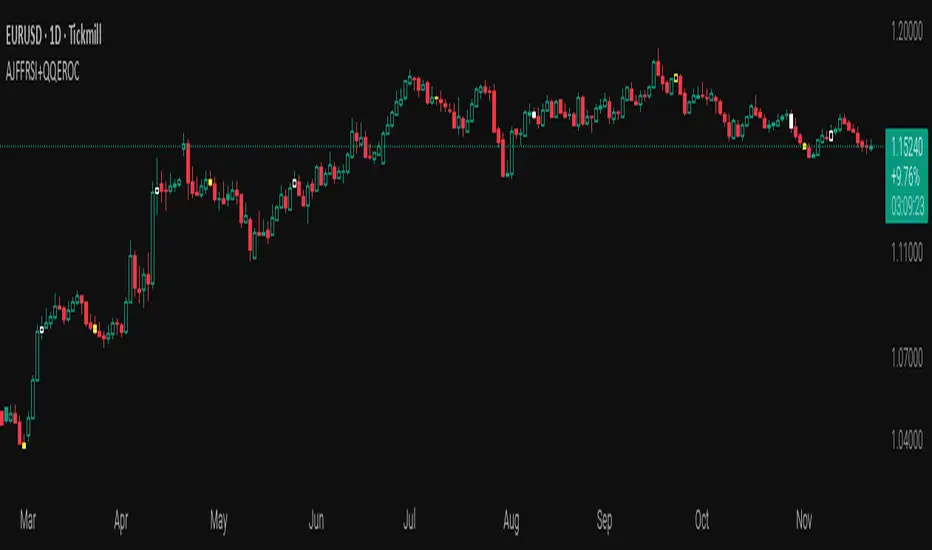
AJFFRSI+QQEROC Uses Jurik RSI for smooth, responsive momentum measurement Incorporates QQE features for trend strength and dynamic trailing stop signals Designed for clearer, more reliable overbought/oversold and reversal signals on TradingView Suitable for intraday, swing, and longer-term analysis Not a financial advice. DYORChỉ báo Pine Script®của losfalco-User-1f670Cập nhật 5
Stochastic BTC OptimizedEnhanced Stochastic for Bitcoin (BTC) – Optimized for Daily Timeframe This enhanced Stochastic oscillator is specifically fine-tuned for BTC/USD on the 1D timeframe, leveraging historical data from Bitstamp (2011–2025) to minimize false signals and maximize reliability in Bitcoin's volatile swings. Unlike the classic Stochastic (14, 3, 3), this version uses optimized parameters: - K Period = 21 – smoother reaction, better suited for BTC’s macro cycles - D Period = 3, Smooth K = 3 – reduces noise while preserving responsiveness - Overbought = 85, Oversold = 15 – accounts for BTC’s tendency to trend strongly within extreme zones without immediate reversal ✅ Smart Signal Logic: Buy/sell signals appear only when %K crosses %D inside the oversold (≤15) or overbought (≥85) zones, and only the first signal is shown to avoid whipsaws. Visual Enhancements: - Thick lines when %K/%D are in overbought/oversold zones - Green/red background highlights on valid signals - Optional up/down arrows for clear entry visualization - Customizable colors, line widths, and transparency 🔒 No alerts included – clean, focused on price action and momentum. 💡 Pro Tip: For even higher accuracy, use this indicator in combination with a long-term trend filter (e.g., EMA 200). The oscillator excels in ranging or retracement phases but should not be used alone in strong parabolic moves. Based on Mozilla Public License v2.0 – feel free to use, modify, and share. Perfect for swing traders and long-term Bitcoin analysts seeking high-probability reversal zones. перевод на русский Улучшенный Stochastic для Bitcoin (BTC) — оптимизирован для дневного таймфрейма Этот улучшенный осциллятор Stochastic специально настроен под BTC/USD на дневном графике, с учётом исторических данных Bitstamp (2011–2025), чтобы минимизировать ложные сигналы и повысить надёжность в условиях высокой волатильности биткоина. В отличие от классического Stochastic (14, 3, 3), эта версия использует оптимизированные параметры: - Период K = 21 — более плавная реакция, лучше соответствует макроциклам BTC - Период D = 3, Сглаживание K = 3 — снижает шум, сохраняя отзывчивость - Уровень перекупленности = 85, перепроданности = 15 — учитывает склонность BTC к сильным трендам в экстремальных зонах без немедленного разворота ✅ Интеллектуальная логика сигналов: Покупка/продажа отображается только при пересечении %K и %D внутри зоны перепроданности (≤15) или перекупленности (≥85), и только первый сигнал фиксируется, чтобы избежать «хлыстов». Улучшенная визуализация: - Жирные линии, когда %K/%D находятся в экстремальных зонах - Зелёный/красный фон при появлении сигналов - Опциональные стрелки для чёткого отображения точек входа - Настройка цветов, толщины линий и прозрачности 🔒 Без алертов — чистый инструмент, сфокусированный на цене и импульсе. 💡 Совет профессионала: для ещё большей точности используйте этот индикатор вместе с трендовым фильтром (например, EMA 200). Осциллятор лучше всего работает в фазах консолидации или отката, но не стоит применять его в одиночку во время сильных параболических движений. На основе Mozilla Public License v2.0 — свободно используйте, модифицируйте и делитесь. Идеален для свинг-трейдеров и аналитиков Bitcoin, ищущих зоны с высокой вероятностью разворота. Chỉ báo Pine Script®của indexrate12
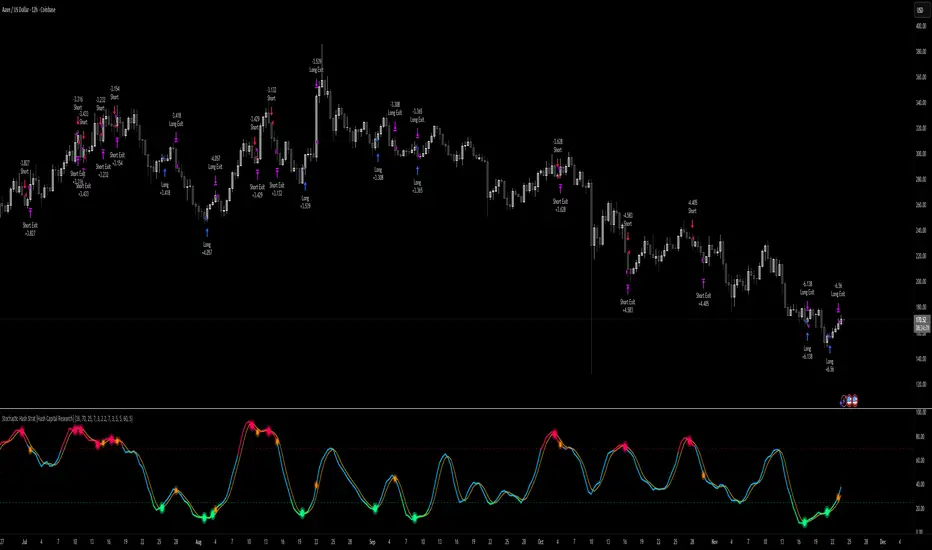
Stochastic Hash Strat [Hash Capital Research]# Stochastic Hash Strategy by Hash Capital Research ## 🎯 What Is This Strategy? The **Stochastic Slow Strategy** is a momentum-based trading system that identifies oversold and overbought market conditions to capture mean-reversion opportunities. Think of it as a "buy low, sell high" approach with smart mathematical filters that remove emotion from your trading decisions. Unlike fast-moving indicators that generate excessive noise, this strategy uses **smoothed stochastic oscillators** to identify only the highest-probability setups when momentum truly shifts. --- ## 💡 Why This Strategy Works Most traders fail because they: - **Chase prices** after big moves (buying high, selling low) - **Overtrade** in choppy, directionless markets - **Exit too early** or hold losses too long This strategy solves all three problems: 1. **Entry Discipline**: Only trades when the stochastic oscillator crosses in extreme zones (oversold for longs, overbought for shorts) 2. **Cooldown Filter**: Prevents revenge trading by forcing a waiting period after each trade 3. **Fixed Risk/Reward**: Pre-defined stop-loss and take-profit levels ensure consistent risk management **The Math Behind It**: The stochastic oscillator measures where the current price sits relative to its recent high-low range. When it's below 25, the market is oversold (time to buy). When above 70, it's overbought (time to sell). The crossover with its moving average confirms momentum is shifting. --- ## 📊 Best Markets & Timeframes ### ⭐ OPTIMAL PERFORMANCE: **Crude Oil (WTI) - 12H Timeframe** - **Why it works**: Oil markets have predictable volatility patterns and respect technical levels **AAVE/USD - 4H to 12H Timeframe** - **Why it works**: DeFi tokens exhibit strong momentum cycles with clear extremes ### ✅ Also Works Well On: - **BTC/USD** (12H, Daily) - Lower frequency but high win rate - **ETH/USD** (8H, 12H) - Balanced volatility and liquidity - **Gold (XAU/USD)** (Daily) - Classic mean-reversion asset - **EUR/USD** (4H, 8H) - Lower volatility, requires patience ### ❌ Avoid Using On: - Timeframes below 4H (too much noise) - Low-liquidity altcoins (wide spreads kill performance) - Strongly trending markets without pullbacks (Bitcoin in 2021) - News-driven instruments during major events --- ## 🎛️ Understanding The Settings ### Core Stochastic Parameters **Stochastic Length (Default: 16)** - Controls the lookback period for price comparison - Lower = faster reactions, more signals (10-14 for volatile markets) - Higher = smoother signals, fewer trades (16-21 for stable markets) - **Pro tip**: Use 10 for crypto 4H, 16 for commodities 12H **Overbought Level (Default: 70)** - Threshold for short entries - Lower values (65-70) = more trades, earlier entries - Higher values (75-80) = fewer but higher-conviction trades - **Sweet spot**: 70 works for most assets **Oversold Level (Default: 25)** - Threshold for long entries - Higher values (25-30) = more trades, earlier entries - Lower values (15-20) = fewer but stronger bounce setups - **Sweet spot**: 20-25 depending on market conditions **Smooth K & Smooth D (Default: 7 & 3)** - Additional smoothing to filter out whipsaws - K=7 makes the indicator slower and more reliable - D=3 is the signal line that confirms the trend - **Don't change these unless you know what you're doing** --- ### Risk Management **Stop Loss % (Default: 2.2%)** - Automatically exits losing trades - Should be 1.5x to 2x your average market volatility - Too tight = death by a thousand cuts - Too wide = uncontrolled losses - **Calibration**: Check ATR indicator and set SL slightly above it **Take Profit % (Default: 7%)** - Automatically exits winning trades - Should be 2.5x to 3x your stop loss (reward-to-risk ratio) - This default gives 7% / 2.2% = 3.18:1 R:R - **The golden rule**: Never have R:R below 2:1 --- ### Trade Filters **Bar Cooldown Filter (Default: ON, 3 bars)** - **What it does**: Forces you to wait X bars after closing a trade before entering a new one - **Why it matters**: Prevents emotional revenge trading and overtrading in choppy markets - **Settings guide**: - 3 bars = Standard (good for most cases) - 5-7 bars = Conservative (oil, slow-moving assets) - 1-2 bars = Aggressive (only for experienced traders) **Exit on Opposite Extreme (Default: ON)** - Closes your long when stochastic hits overbought (and vice versa) - Acts as an early profit-taking mechanism - **Leave this ON** unless you're testing other exit strategies **Divergence Filter (Default: OFF)** - Looks for price/momentum divergences for additional confirmation - **When to enable**: Trending markets where you want fewer but higher-quality trades - **Keep OFF for**: Mean-reverting markets (oil, forex, most of the time) --- ## 🚀 Quick Start Guide ### Step 1: Set Up in TradingView 1. Open TradingView and navigate to your chart 2. Click "Pine Editor" at the bottom 3. Copy and paste the strategy code 4. Click "Add to Chart" 5. The strategy will appear in a separate pane below your price chart ### Step 2: Choose Your Market **If you're trading Crude Oil:** - Timeframe: 12H - Keep all default settings - Watch for signals during London/NY overlap (8am-11am EST) **If you're trading AAVE or crypto:** - Timeframe: 4H or 12H - Consider these adjustments: - Stochastic Length: 10-14 (faster) - Oversold: 20 (more aggressive) - Take Profit: 8-10% (higher targets) ### Step 3: Wait for Your First Signal **LONG Entry** (Green circle appears): - Stochastic crosses up below oversold level (25) - Price likely near recent lows - System places limit order at take profit and stop loss **SHORT Entry** (Red circle appears): - Stochastic crosses down above overbought level (70) - Price likely near recent highs - System places limit order at take profit and stop loss **EXIT** (Orange circle): - Position closes either at stop, target, or opposite extreme - Cooldown period begins ### Step 4: Let It Run The biggest mistake? **Interfering with the system.** - Don't close trades early because you're scared - Don't skip signals because you "have a feeling" - Don't increase position size after a big win - Don't revenge trade after a loss **Follow the system or don't use it at all.** --- ### Important Risks: 1. **Drawdown Pain**: You WILL experience losing streaks of 5-7 trades. This is mathematically normal. 2. **Whipsaw Markets**: Choppy, range-bound conditions can trigger multiple small losses. 3. **Gap Risk**: Overnight gaps can cause your actual fill to be worse than the stop loss. 4. **Slippage**: Real execution prices differ from backtested prices (factor in 0.1-0.2% slippage). --- ## 🔧 Optimization Guide ### When to Adjust Settings: **Market Volatility Increased?** - Widen stop loss by 0.5-1% - Increase take profit proportionally - Consider increasing cooldown to 5-7 bars **Getting Too Few Signals?** - Decrease stochastic length to 10-12 - Increase oversold to 30, decrease overbought to 65 - Reduce cooldown to 2 bars **Getting Too Many Losses?** - Increase stochastic length to 18-21 (slower, smoother) - Enable divergence filter - Increase cooldown to 5+ bars - Verify you're on the right timeframe ### A/B Testing Method: 1. **Run default settings for 50 trades** on your chosen market 2. Document: Win rate, profit factor, max drawdown, emotional tolerance 3. **Change ONE variable** (e.g., oversold from 25 to 20) 4. Run another 50 trades 5. Compare results 6. Keep the better version **Never change multiple settings at once** or you won't know what worked. --- ## 📚 Educational Resources ### Key Concepts to Learn: **Stochastic Oscillator** - Developed by George Lane in the 1950s - Measures momentum by comparing closing price to price range - Formula: %K = (Close - Low) / (High - Low) × 100 - Similar to RSI but more sensitive to price movements **Mean Reversion vs. Trend Following** - This is a **mean reversion** strategy (price returns to average) - Works best in ranging markets with defined support/resistance - Fails in strong trending markets (2017 Bitcoin, 2020 Tech stocks) - Complement with trend filters for better results **Risk:Reward Ratio** - The cornerstone of profitable trading - Winning 40% of trades with 3:1 R:R = profitable - Winning 60% of trades with 1:1 R:R = breakeven (after fees) - **This strategy aims for 45% win rate with 2.5-3:1 R:R** ### Recommended Reading: - *"Trading Systems and Methods"* by Perry Kaufman (Chapter on Oscillators) - *"Mean Reversion Trading Systems"* by Howard Bandy - *"The New Trading for a Living"* by Dr. Alexander Elder --- ## 🛠️ Troubleshooting ### "I'm not seeing any signals!" **Check:** - Is your timeframe 4H or higher? - Is the stochastic actually reaching extreme levels (check if your asset is stuck in middle range)? - Is cooldown still active from a previous trade? - Are you on a low-liquidity pair? **Solution**: Switch to a more volatile asset or lower the overbought/oversold thresholds. --- ### "The strategy keeps losing money!" **Check:** - What's your win rate? (Below 35% is concerning) - What's your profit factor? (Below 0.8 means serious issues) - Are you trading during major news events? - Is the market in a strong trend? **Solution**: 1. Verify you're using recommended markets/timeframes 2. Increase cooldown period to avoid choppy markets 3. Reduce position size to 5% while you diagnose 4. Consider switching to daily timeframe for less noise --- ### "My stop losses keep getting hit!" **Check:** - Is your stop loss tighter than the average ATR? - Are you trading during high-volatility sessions? - Is slippage eating into your buffer? **Solution**: 1. Calculate the 14-period ATR 2. Set stop loss to 1.5x the ATR value 3. Avoid trading right after market open or major news 4. Factor in 0.2% slippage for crypto, 0.1% for oil --- ## 💪 Pro Tips from the Trenches ### Psychological Discipline **The Three Deadly Sins:** 1. **Skipping signals** - "This one doesn't feel right" 2. **Early exits** - "I'll just take profit here to be safe" 3. **Revenge trading** - "I need to make back that loss NOW" **The Solution:** Treat your strategy like a business system. Would McDonald's skip making fries because the cashier "doesn't feel like it today"? No. Systems work because of consistency. --- ### Position Management **Scaling In/Out** (Advanced) - Enter 50% position at signal - Add 50% if stochastic reaches 10 (oversold) or 90 (overbought) - Exit 50% at 1.5x take profit, let the rest run **This is NOT for beginners.** Master the basic system first. --- ### Market Awareness **Oil Traders:** - OPEC meetings = volatility spikes (avoid or widen stops) - US inventory reports (Wed 10:30am EST) = avoid trading 2 hours before/after - Summer driving season = different patterns than winter **Crypto Traders:** - Monday-Tuesday = typically lower volatility (fewer signals) - Thursday-Sunday = higher volatility (more signals) - Avoid trading during exchange maintenance windows --- ## ⚖️ Legal Disclaimer This trading strategy is provided for **educational purposes only**. - Past performance does not guarantee future results - Trading involves substantial risk of loss - Only trade with capital you can afford to lose - No one associated with this strategy is a licensed financial advisor - You are solely responsible for your trading decisions **By using this strategy, you acknowledge that you understand and accept these risks.** --- ## 🙏 Acknowledgments Strategy development inspired by: - George Lane's original Stochastic Oscillator work - Modern quantitative trading research - Community feedback from hundreds of backtests Built with ❤️ for retail traders who want systematic, disciplined approaches to the markets. --- **Good luck, stay disciplined, and trade the system, not your emotions.** Chiến lược Pine Script®của Hash_Capital90
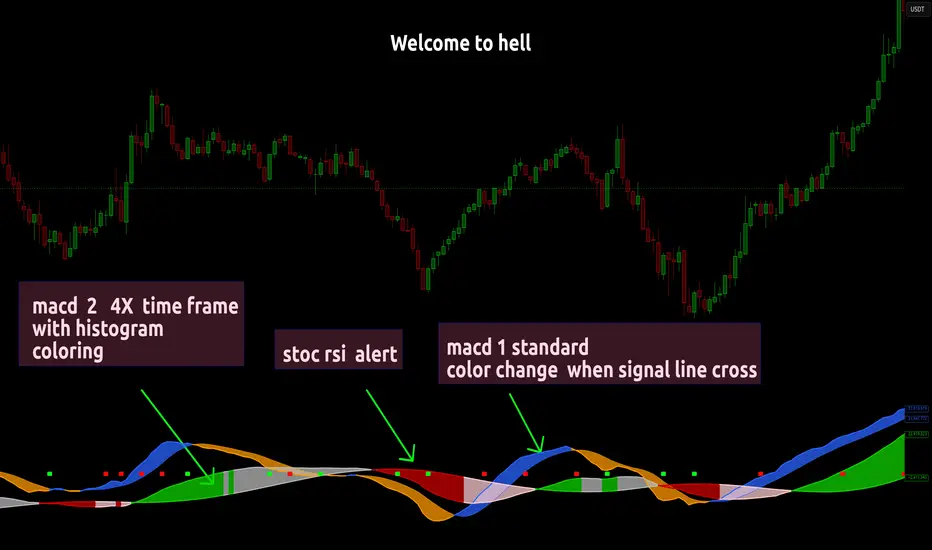
Dual MACD With Pilot Background + + Stoch RSI Alert HELL 2macd 1 chart time macd 2 4x chart time with over bought and over sold stoc rsi alertsChỉ báo Pine Script®của gman460
SMI Color Red/Green📌 TradingView Description – SMI Red/Green Momentum Line 🔥 Stochastics Momentum Index (SMI) – Dynamic Red/Green Version This indicator is an enhanced and modernized version of the Stochastic Momentum Index (SMI), designed to deliver a more visual, intuitive, and responsive view of trend momentum. It includes: ✔️ Smoothed SMI ✔️ Dynamic Red/Green momentum coloring ✔️ Signal EMA line ✔️ Overbought/Oversold zones with shading 🎨 Dynamic Red/Green SMI Line The main SMI line automatically changes color based on momentum direction: Green → Bullish momentum (SMI rising) Red → Bearish momentum (SMI falling) This provides instant visual feedback and highlights early momentum changes even before traditional signal-line crossovers. 📉 Indicator Structure 1️⃣ Smoothed SMI The SMI is calculated using the price’s position inside its range and then smoothed with an SMA to reduce noise. 2️⃣ EMA Signal Line A customizable EMA acts as a signal line, providing: Clear bullish/bearish crossovers Trend confirmation Cleaner entry/exit signals 3️⃣ Overbought / Oversold Zones Extreme levels are highlighted using color-filled zones: Red Zone (Overbought) → potential bearish reversal Green Zone (Oversold) → potential bullish reversal Levels are fully adjustable. 💡 How to Use It The indicator works exceptionally well across all timeframes. The most powerful signals are: ✔️ SMI crossing above/below the EMA SMI crosses above EMA → bullish signal SMI crosses below EMA → bearish signal ✔️ Leaving Overbought/Oversold zones SMI exits the oversold zone → potential long setup SMI exits the overbought zone → potential short setup ✔️ Color shifts (momentum direction) Red → Green : early bullish momentum Green → Red : early bearish momentum Perfect for scalping, day trading, and swing trading. 🚀 Why This Version Is Better Extremely visual momentum reading Noise reduction through smoothing Instantly readable color-coded trend Strong OB/OS zone visualization Works on any market and timeframe Great in combination with RSI, MACD, HMA, ALMA, and trend filters If you'd like, I can also write: 🔹 a SEO-optimized title, 🔹 recommended TradingView tags, 🔹 or a shorter promotional description.Chỉ báo Pine Script®của maxime1542
MACD FROM HELLthis is a double macd with 2 time frames macd 1 is chart macd 4 is 4X meaning the 1hr becomes the 4hr and it uses the histogram coloring for added detail ,, on top of that it has stochastic rsi Alerts set to trigger when k line goes above 99.9 or below 0.01 and exits ,, alert triggers on exit Chỉ báo Pine Script®của gman477
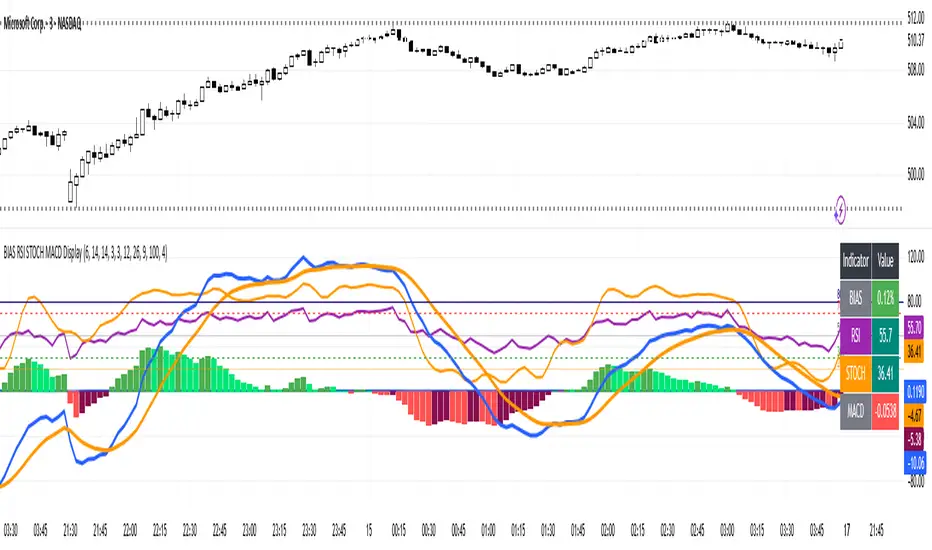
BIAS RSI STOCH MACD Displaysimple but effective to prevent chart clutter. Hi Traders! Today I’m showing you a **custom indicator** that combines **BIAS, RSI, Stochastic, and MACD** in one easy-to-read panel. Let’s break it down: 1️⃣ **BIAS** – Shows how far the price is from its moving average. * Positive BIAS → price is above the average. * Negative BIAS → price is below the average. 2️⃣ **RSI (Relative Strength Index)** – Measures momentum. * Above 70 → overbought * Below 30 → oversold * **50 line added** → midpoint for trend direction 3️⃣ **Stochastic (STOCH)** – Confirms momentum like RSI. * Above 80 → overbought * Below 20 → oversold 4️⃣ **MACD (Moving Average Convergence Divergence)** – Shows trend and momentum. * Histogram colors indicate strength * Lines show trend direction 5️⃣ **Visual Table** – On the top right, you can see all current indicator values at a glance, with color coding for easy interpretation. 6️⃣ **Plots & Levels** – * BIAS, RSI, Stoch are plotted clearly * RSI has **midline at 50** for trend reference * Standard overbought/oversold levels highlighted ✅ **How to Use:** * Look for RSI or Stoch crossing midline or extreme levels for potential entries. * Check MACD histogram and lines for confirmation of trend strength. * Use BIAS to see if price is stretched from the moving average. This indicator is perfect for **momentum, trend, and mean-reversion traders**, giving multiple signals in one pane without clutter. ---Chỉ báo Pine Script®của Joda_Fib_69Cập nhật 9